Navigation:
Index
Splash Page |

 Two Goats and a Donkey! Two Goats and a Donkey!
On The 9th Day of Halloween
Friday, October 9, 2026
Modern Paganism — Part III: Gods, Magic, Nature, Ancestors, and the Practice of Modern Pagan Spirituality
If the first generations of modern Pagans were concerned with recovering and reimagining the religions of the past, contemporary Paganism is ultimately defined by practice. It is experienced through ritual, seasonal celebration, relationships with gods and ancestors, reverence for nature, meditation, offerings, divination, and, for many practitioners, magic. Because Paganism contains no universal creed or central authority, these practices vary enormously. Nevertheless, certain themes appear repeatedly across its many traditions.
Perhaps the most fundamental is the sacredness of nature. Many Pagans understand the natural world not merely as the setting in which spiritual life occurs but as possessing spiritual significance in itself. A forest, river, mountain, spring, or ancient tree may be approached as a sacred place rather than simply a natural resource. For some practitioners, divinity exists throughout nature. Others believe individual places possess spirits or spiritual personalities of their own.
This perspective frequently encourages an awareness of seasonal change. Modern urban life can separate people from the rhythms that governed earlier agricultural societies, yet Pagan ritual deliberately draws attention back to them. The first signs of spring, lengthening summer days, ripening crops, autumn leaves, and winter darkness become occasions for reflection and celebration.
The Wheel of the Year provides one widely used framework for this seasonal spirituality. Its eight festivals mark Samhain, Yule, Imbolc, Ostara, Beltane, Litha, Lughnasadh, and Mabon. Although this complete eightfold calendar is a modern development rather than an intact ancient Celtic system, it has become enormously influential within Wicca and many other Pagan traditions.
Each festival offers its own symbolism. Imbolc emphasizes returning light and renewal. Ostara celebrates spring and increasing fertility. Beltane embraces vitality and the approach of summer. Litha marks the height of the Sun's power around the summer solstice. Lughnasadh recognizes the beginning of harvest. Mabon, a modern name commonly applied to the autumn equinox in Pagan circles, celebrates balance and thanksgiving. Samhain confronts death, ancestry, and the arrival of winter, while Yule celebrates the winter solstice and the gradual return of light.
Not every Pagan follows this calendar. Reconstructionist traditions may instead use calendars based upon the historical cultures they seek to revive. Nevertheless, seasonal observance illustrates an important Pagan principle: sacred time is frequently understood as cyclical rather than simply linear. Birth leads to growth, growth to decline, decline to death, and death eventually to renewal.
Relationships with deities are equally diverse. Modern Pagans may be polytheists, pantheists, animists, duotheists, or something more difficult to categorize. A polytheist may regard Brigid, Odin, Aphrodite, Apollo, or the Morrígan as distinct divine personalities. Another practitioner may understand gods as different manifestations of an underlying divine reality. Still another may approach them psychologically, viewing mythological figures as archetypes through which human beings encounter profound aspects of existence.
For devotional polytheists, relationships with gods may resemble other forms of religious devotion. Practitioners pray, maintain shrines, light candles, burn incense, make offerings, celebrate holy days, and study myths associated with particular deities. Offerings may include bread, milk, wine, flowers, herbs, crafted objects, poetry, or acts of service. The purpose is not necessarily to purchase supernatural favors but to establish reciprocity—a continuing relationship between the human and divine worlds.
Ancestors may receive similar attention. Ancestor veneration appears in several contemporary Pagan traditions, particularly Heathenry and some Celtic-inspired practices. Photographs, heirlooms, candles, and offerings may be placed upon household altars. Samhain has become an especially important occasion for remembering those who have died.
The concept of ancestry, however, can extend beyond biological descent. Some practitioners honor cultural ancestors, spiritual teachers, historical figures, or the generations of people who inhabited a particular landscape. Ancestor practice can therefore become an exploration of memory and continuity rather than simply genealogy.
Magic represents another prominent, though not universal, aspect of Pagan practice. Not all Pagans practice magic, and not everyone who practices witchcraft identifies as Pagan. Where the two intersect, magic is often understood as the intentional use of ritual, symbolism, concentration, and spiritual forces to encourage change.
Modern magical practices can include candle magic, herbalism, charms, sigils, spellwork, ritual magic, meditation, visualization, and divination. Some practitioners interpret these activities literally as interactions with supernatural forces. Others understand them partly or entirely through psychological processes. Pagan communities contain both perspectives, along with numerous positions between them.
Divination is similarly widespread. Tarot cards, runes, ogham, pendulums, astrology, and other systems may be used to contemplate questions or seek spiritual guidance. Historically based traditions sometimes favor divinatory methods associated with the cultures they study, while eclectic practitioners may use several systems.
Ritual provides the structure through which many of these elements come together. A Wiccan ritual, for example, may begin with creating sacred space and casting a circle. Candles might represent the elements or directions. Deities may be invoked, offerings presented, magical work performed, and food and drink shared before the ritual concludes and the circle is opened.
Other Pagan traditions use very different forms. A Heathen gathering may center upon offerings and communal expressions of honor to gods and ancestors. A Druid ceremony might take place outdoors and include poetry, meditation, music, and recognition of the spirits of the landscape. A reconstructionist rite may attempt to follow patterns derived from historical sources.
The altar is one of the most visible expressions of personal Pagan practice. It may contain statues of deities, candles, bowls for offerings, incense, stones, seasonal decorations, photographs of ancestors, or objects gathered from nature. Some altars remain permanently established, while others appear only during ritual.
The Moon also holds considerable significance in many contemporary traditions. Wiccans and witches may observe the full Moon through rituals often called Esbats. The waxing Moon can symbolize growth and increase, the full Moon fulfillment and power, and the waning Moon release or decline. These associations are particularly prominent in modern witchcraft, though they should not automatically be projected backward onto all ancient Pagan cultures.
Behind these varied practices lies an important characteristic of modern Pagan spirituality: direct participation. Religious experience is not necessarily mediated through clergy or institutions. The practitioner may construct the altar, speak the prayer, make the offering, perform the ritual, study the mythology, and develop a personal relationship with the sacred.
This freedom also brings responsibility. Without a universal scripture or religious authority, practitioners must decide which sources they trust and how they distinguish historical tradition from modern invention. Contemporary Paganism therefore often combines spirituality with study. Archaeology, folklore, mythology, history, and religious scholarship can exist alongside ritual and personal experience.
Ultimately, modern Pagan practice transforms abstract ideas about ancient religion into lived spirituality. The changing Moon becomes an occasion for reflection. A bowl of water becomes an offering. A family photograph becomes a connection with ancestors. The return of spring becomes sacred renewal, while the darkness of Samhain becomes an invitation to remember mortality and those who came before.
Through these practices, modern Paganism attempts to restore something that many practitioners believe contemporary life has obscured: awareness of humanity's place within larger cycles. The seasons turn, generations pass, the Moon waxes and wanes, and landscapes endure beyond individual lifetimes. Pagan spirituality places the individual within those rhythms.
In doing so, it creates a religious world in which the sacred is not necessarily distant. It may be encountered beneath an ancient tree, beside a household candle, within an old story, before an ancestor's photograph, under a full Moon, or in the simple recognition that human life remains inseparable from the living world around it.
Day nine is a done deal now! Halloween is that much closer! Stay tuned for Part 4 of the Modern Paganism discussion tomorrow!
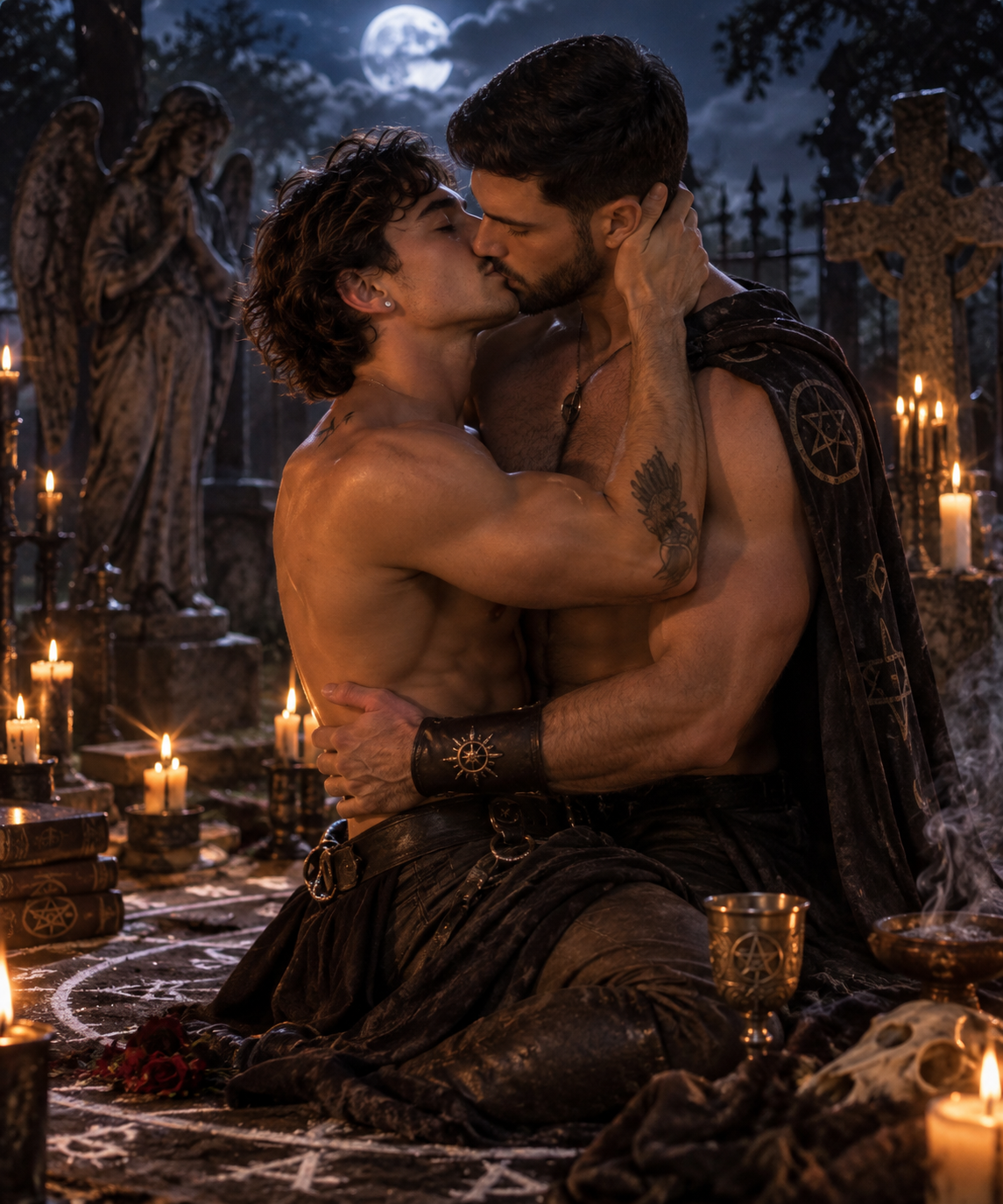
The images below are all AI-generated by me with ChatGPT, Grok, and Google Gemini on my iPhone. Enjoy!

The 31 Days of Halloween! Click on the day number you want! 01 | 02 | 03 | 04 | 05 | 06 | 07 | 08 | 09 | 10 | 11 | 12 | 13 | 14 | 15 | 16 | 17 | 18 | 19 | 20 | 21 | 22 | 23 | 24 | 25 | 26 | 27 | 28 | 29 | 30 | 31
George
|