Navigation:
Index
Splash Page |

 Two Goats and a Donkey! Two Goats and a Donkey!
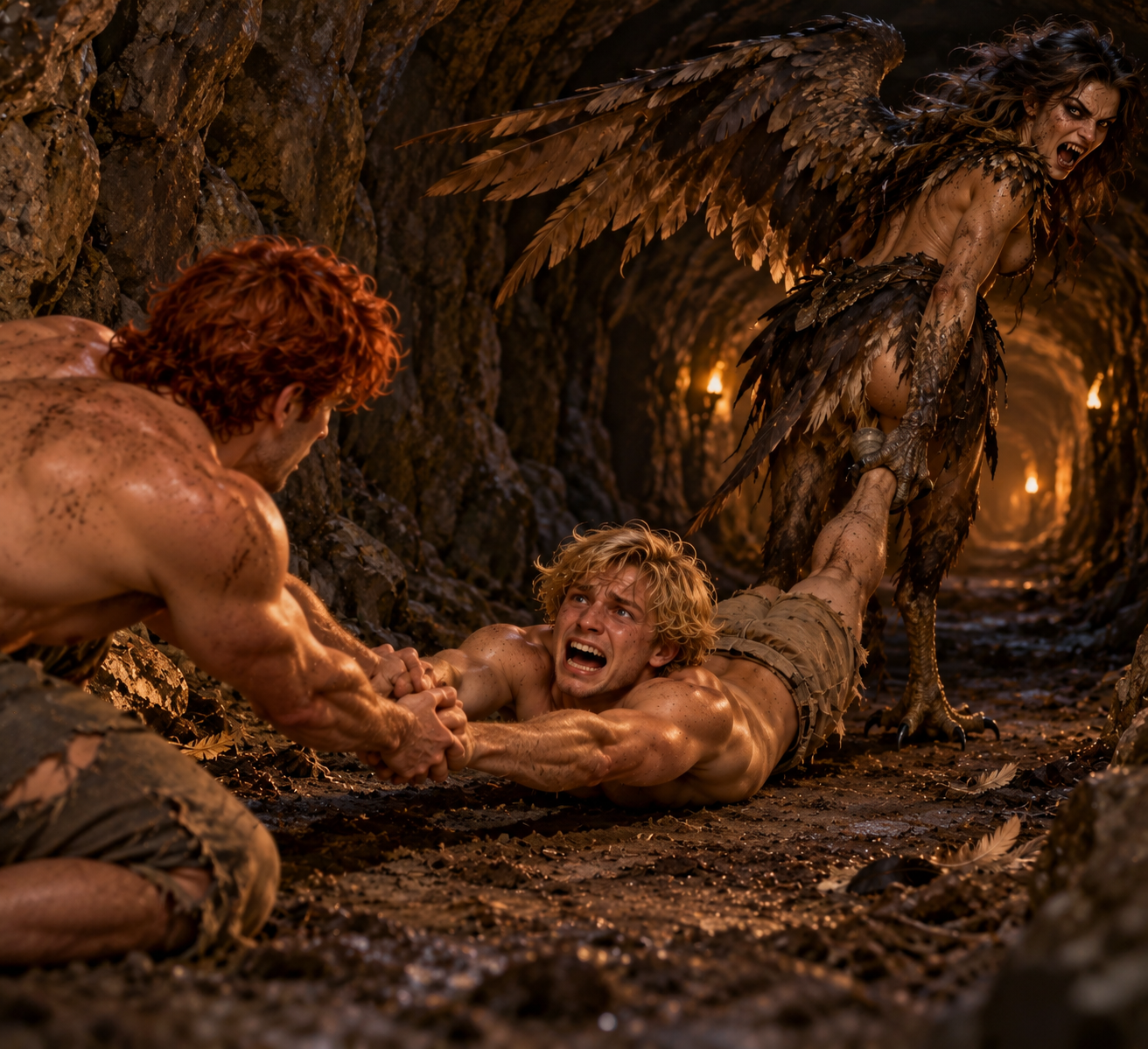
On The 30th Day of Halloween
Friday, October 29, 2026
At the Crossroads and Behind the Door: Halloween, Haunted Places, and the American Imagination
Halloween is a holiday of places as much as creatures. Certain landscapes seem almost naturally suited to it: cemeteries under moonlight, forests stripped of leaves, lonely roads, abandoned churches, mist-covered fields, and houses with darkened windows. Yet two settings possess especially powerful symbolic importance. The first is the crossroads, an ancient image of decision, uncertainty, supernatural encounter, and the meeting of different worlds. The second is the haunted house, one of the defining images of American horror, where the familiar safety of home becomes unstable and the past refuses to remain buried.
At first glance, these two places seem very different. A crossroads is open, exposed, and transitional. A haunted house is enclosed, private, and rooted to one location. One represents movement; the other represents entrapment. Yet both are built upon the same fundamental fear: the ordinary world may contain invisible boundaries, and crossing one of them may have consequences.
This is precisely why both fit Halloween so well. Halloween traditionally celebrates the weakening of boundaries. The living imitate the dead. Children become monsters. Homes become graveyards. Streets fill with masked strangers. The familiar becomes unfamiliar. At the crossroads, a traveler must choose where to go. In the haunted house, someone has already crossed a threshold and may discover that leaving is harder than entering.
Together, the crossroads and the haunted house reveal two sides of Halloween. One asks, “Which direction will you choose?” The other asks, “What has followed you home?”
The Crossroads: Where Paths and Worlds Meet
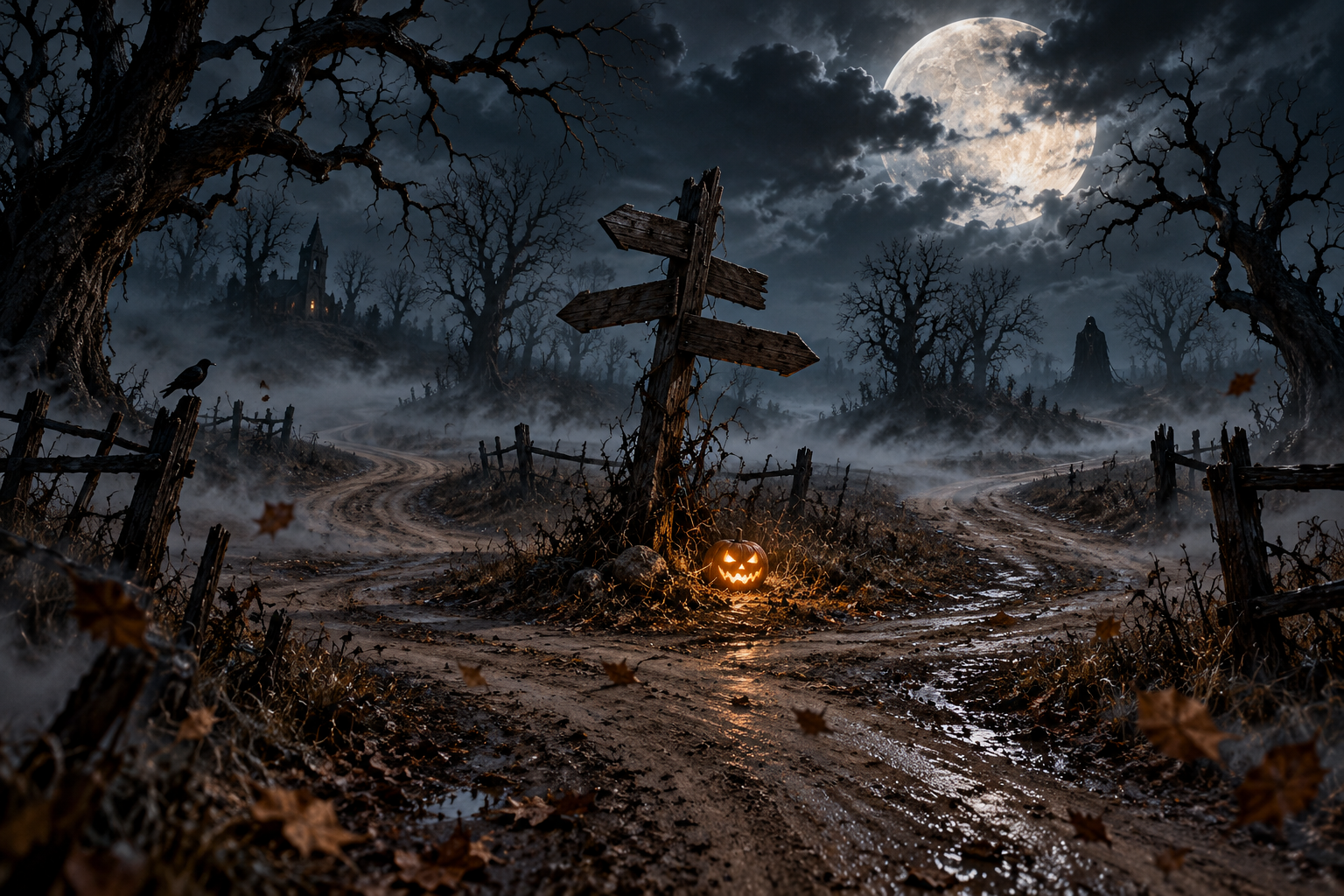 The crossroads is one of humanity’s oldest supernatural symbols because its meaning begins with something completely practical. A crossroads is a place where movement stops being simple. A traveler approaching an intersection must decide which direction to take. One road becomes several. The future branches. That moment of uncertainty gives the crossroads symbolic power. A straight road suggests certainty. A crossroads suggests possibility. In folklore, possibility can easily become danger. The crossroads is one of humanity’s oldest supernatural symbols because its meaning begins with something completely practical. A crossroads is a place where movement stops being simple. A traveler approaching an intersection must decide which direction to take. One road becomes several. The future branches. That moment of uncertainty gives the crossroads symbolic power. A straight road suggests certainty. A crossroads suggests possibility. In folklore, possibility can easily become danger.
If travelers do not know which path is correct, they may become lost. If several roads meet, strangers may also meet there. Before modern road signs, streetlights, GPS navigation, and detailed maps, intersections in rural landscapes could become genuine places of confusion. At night, the uncertainty increased. A wrong choice might lead miles away from shelter. Folklore magnified this ordinary anxiety into supernatural significance. The crossroads became a place where the normal order of the landscape weakened.
Crossroads and Liminality
Anthropologists and folklorists often use the word liminal to describe spaces or moments existing between established categories. A doorway is liminal because it stands between inside and outside. Twilight is liminal because it exists between day and night. A shoreline exists between land and water.
The crossroads is especially liminal because it is not merely between two spaces. It is the point where several possibilities collide. A person standing at the center belongs temporarily to no single road. This condition made crossroads attractive locations for supernatural stories. If ghosts, gods, spirits, demons, or magical beings were thought to move between worlds, then the place where earthly roads intersected could symbolically resemble the place where invisible worlds intersected as well.
Halloween carries similar symbolism.
The holiday itself occupies a cultural threshold. It arrives late in autumn, when daylight shortens dramatically and winter approaches. Historically, traditions surrounding Samhain in Ireland and Scotland associated the beginning of November with seasonal transition. Later Christian observances of All Saints’ and All Souls’ placed additional emphasis on death and remembrance at the same time of year. The modern Halloween crossroads therefore does not need to be historically connected to one single ancient Celtic ritual in order to feel appropriate. Both Halloween and the crossroads represent transition.
Hecate and the Ancient Crossroads
One of the most famous supernatural associations with crossroads comes from ancient Greece.
The goddess Hecate developed strong connections with boundaries, doorways, night, ghosts, magic, and crossroads. In later Greek and Roman tradition she was sometimes represented in triple form, allowing her to face several directions simultaneously. This image made perfect symbolic sense. A deity standing at an intersection needed to see every road. Offerings could be left for Hecate at crossroads, particularly at three-way intersections. Such practices contributed to the enduring Western association between crossroads, magic, spirits, and nocturnal ritual. Hecate later became strongly associated with witchcraft in European literature and art, particularly through later classical reception and works such as Shakespeare’s *Macbeth*. As witches became central Halloween symbols, the crossroads indirectly inherited additional Halloween resonance. A witch at a crossroads seems immediately plausible because both belong to cultural ideas about boundaries and forbidden knowledge.
The Devil at the Crossroads
Christian folklore transformed the supernatural crossroads in another direction. Instead of gods and spirits, the traveler might meet the Devil. Stories developed in which people encountered demonic figures at crossroads and made bargains in exchange for wealth, knowledge, power, beauty, or extraordinary talent. The basic structure is powerful because the crossroads already represents choice. The supernatural bargain externalizes that choice. One road leads toward ordinary life. Another leads toward forbidden possibility. The traveler must decide. The price may not become clear until later. These stories became particularly prominent in legends surrounding musicians, magicians, and people believed to possess abilities beyond ordinary explanation. The crossroads therefore became not merely a place where roads intersected, but a place where ambition met temptation.
Robert Johnson and the American Crossroads Legend
In American culture, perhaps the most famous crossroads legend surrounds blues musician Robert Johnson. Johnson was an exceptionally influential guitarist and songwriter whose short life became surrounded by myth after his death. One popular legend claimed that he acquired his remarkable musical ability by meeting the Devil at a Mississippi crossroads and exchanging his soul for mastery of the guitar. The story has become so famous that it sometimes overshadows the real musician. There is no reliable evidence that Johnson literally claimed to have sold his soul to the Devil. The legend grew through a mixture of folklore, later storytelling, interpretations of blues lyrics, and older traditions concerning supernatural musical ability. Nevertheless, the story became one of the most powerful American versions of the crossroads bargain.
The Mississippi landscape gave the legend a distinctly Southern Gothic atmosphere. A lonely rural intersection. Midnight. A man carrying a guitar. A stranger waiting beside the road. The story could almost have been designed for Halloween. Its power comes from uncertainty. The audience does not need to believe the Devil actually appeared. The possibility is enough.
Crossroads and the Dead
Crossroads also acquired associations with burial and restless spirits. In parts of Europe, people considered socially dangerous or spiritually troubling were sometimes buried at crossroads rather than within ordinary consecrated cemeteries. Suicides, criminals, or people believed capable of returning from the dead could be treated differently in death. The symbolic logic was striking. If the spirit attempted to return, the many intersecting roads might confuse it. The crossroads therefore functioned simultaneously as boundary, trap, and containment device. This idea strengthens its Halloween character. Halloween folklore is filled with spirits unable to remain where the living believe they belong. The ghost crosses from death into life. The vampire leaves the grave. The restless dead return to unfinished places. At the crossroads, the living and dead might briefly occupy the same geography.
The Crossroads at Midnight
Time can be liminal just as place can. Midnight occupies the boundary between one day and another. Crossroads occupy the boundary between one road and another. Put the two together and folklore receives a double threshold. This is why supernatural crossroads stories so frequently occur at midnight. A person arrives at the intersection at precisely the moment when both place and time are uncertain. Halloween provides a third threshold. Now the night itself is culturally associated with ghosts, witches, masks, death, and supernatural possibility. The image becomes nearly perfect: Halloween night, midnight, at a crossroads. Three boundaries converge. Even someone who does not believe in ghosts can understand why the setting feels charged.
Crossroads as Choice
At its deepest level, however, the crossroads is not frightening because of demons. It is frightening because of decisions. Every major life choice creates roads not taken. Marriage, love, career, migration, betrayal, forgiveness, revenge, ambition—all involve selecting one future at the expense of another. The crossroads turns this invisible psychological experience into geography. A person stands still. Several paths continue. Only one can be chosen. Horror thrives on this uncertainty. What if the wrong road is taken? What if the traveler chooses correctly but something follows? What if the crossroads does not offer a choice at all but merely creates the illusion of one? Halloween stories repeatedly exploit exactly these fears.
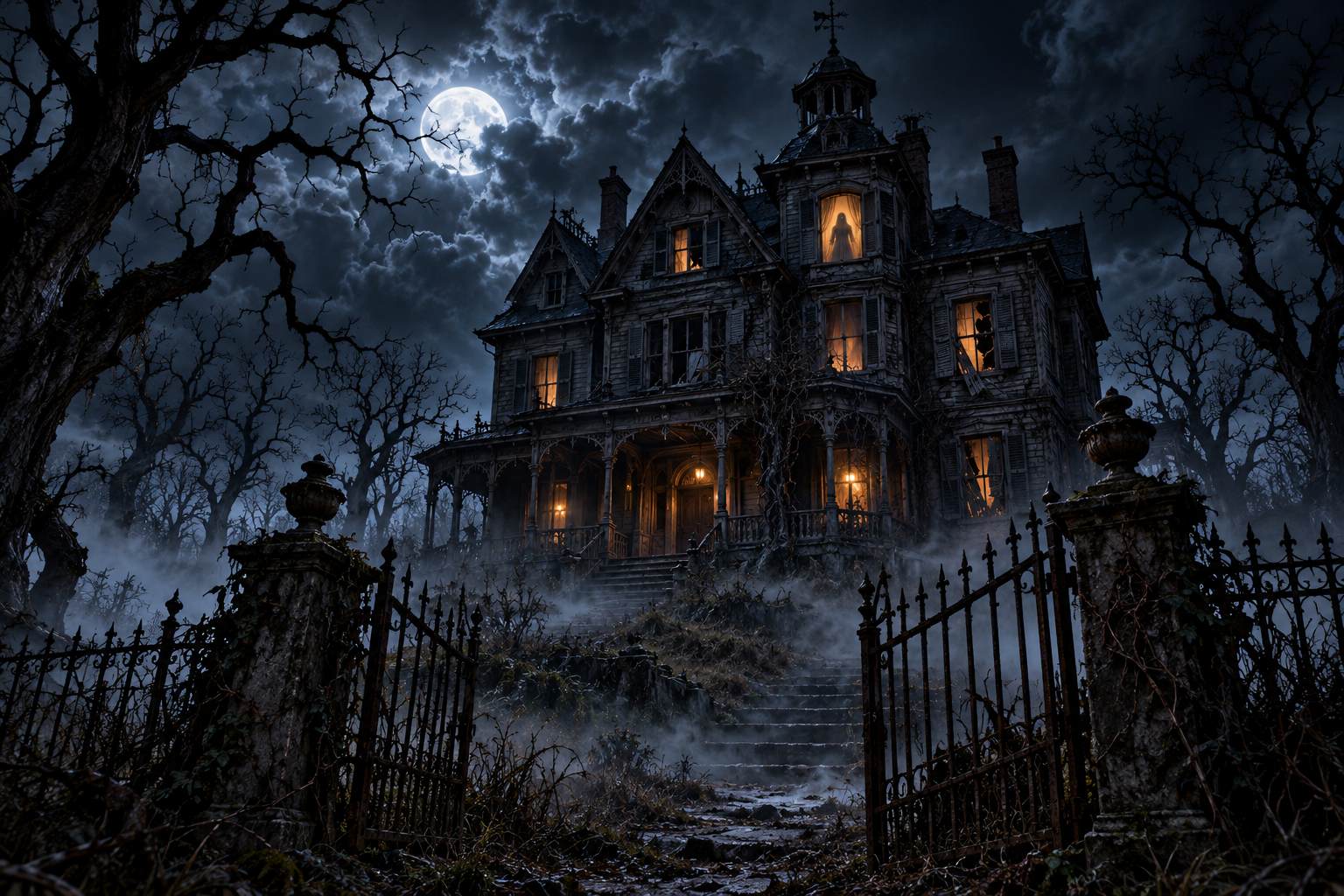 The Haunted House: Horror Comes Home The Haunted House: Horror Comes Home
If the crossroads represents movement and decision, the haunted house represents the opposite. It stands still. People come to it. The haunted house may be one of the most important symbols in American horror because it corrupts something fundamental: the expectation that home is safe. A home is supposed to protect its inhabitants from the outside world. Walls keep weather and strangers out.
Doors lock. Windows close. Bedrooms provide privacy. Family history accumulates within familiar rooms. The haunted house reverses every assumption.
The danger is already inside.
Sometimes it has been there for generations.
The European Gothic House
The American haunted house descended partly from European Gothic literature. Early Gothic novels favored enormous castles, ruined monasteries, ancestral estates, hidden chambers, crypts, tunnels, and family secrets. Buildings became physical manifestations of the past. A castle was frightening precisely because it had existed longer than the current inhabitants. Its architecture remembered. The old European manor therefore became an ideal setting for stories about inheritance, family guilt, secret crimes, madness, and supernatural revenge. When Gothic storytelling crossed the Atlantic, however, American culture developed its own architectural vocabulary.
America had fewer medieval castles. It had farmhouses. Plantation houses. Victorian mansions. Townhouses. Hotels. Suburban homes. Abandoned hospitals. Old schools. The haunted structure changed, but the principle survived.
The American House and the American Dream
The haunted house became especially powerful in the United States because home ownership acquired enormous symbolic importance. The American house could represent independence, prosperity, family stability, privacy, and upward mobility. Owning a home meant possessing a piece of the American dream. Horror asked a simple question: What if the dream were already occupied?
The family purchases the house. The price seems surprisingly low. The rooms are beautiful. The neighborhood appears peaceful. Then someone hears footsteps upstairs. A door opens by itself. A child begins speaking to someone who is not visible. The walls contain something. The previous owners did not leave willingly. The fantasy of possession reverses. The family does not own the house. The house owns them.
Edgar Allan Poe and the Diseased House
Edgar Allan Poe helped establish an American tradition in which the house reflects the psychological condition of its inhabitants. In “The Fall of the House of Usher,” the word “house” refers both to a physical building and to a family line. The mansion is decaying. The family is decaying. The boundaries between architecture, mind, body, and ancestry collapse. This became one of the central ideas of American haunted-house fiction. Buildings do not merely contain horror. They embody it. Cracks in walls can represent cracks in families. Locked rooms represent secrets. Basements contain what has been repressed. Attics preserve what has been forgotten. Staircases connect different layers of memory. The haunted house becomes a psychological map.
The Winchester Mystery House
American history also produced real buildings that entered haunted-house legend. One of the most famous is the Winchester Mystery House in California, built and continually altered by Sarah Winchester, widow of firearms heir William Wirt Winchester. Popular legend later claimed that Winchester endlessly expanded the house because she believed spirits of people killed by Winchester rifles were haunting her and that construction had to continue to appease or confuse them. Many details of this supernatural story are difficult to verify historically, and later tourism helped amplify the legend. Yet the story became culturally powerful because it linked three deeply American themes: wealth, violence, and haunting. The fortune generated by firearms supposedly created a house filled with ghosts. Whether literally true or not, the legend works symbolically. Prosperity cannot escape the violence that made it possible. The mansion becomes a conscience built out of wood.
The Haunted Plantation
A darker form of American haunted-house mythology appears in stories surrounding Southern plantation homes. These buildings are sometimes marketed through ghost stories involving mysterious women, murdered residents, duels, unexplained footsteps, or tragic romances. Yet the actual history beneath plantation architecture is far more disturbing than many commercial ghost tours acknowledge. Plantations were built upon slavery. Thousands of enslaved people lived, worked, suffered, resisted, formed families, and died within those landscapes. The real horror is historical. When plantation tourism focuses only on romantic ghosts while minimizing slavery, haunting can become a way of avoiding the very past supposedly returning. The most meaningful haunted-house symbolism asks the opposite question: What happens when a culture refuses to confront what happened inside its own beautiful houses? The haunting then becomes moral memory. The dead return because the living have edited the story.
Shirley Jackson and the House That Watches
Shirley Jackson’s The Haunting of Hill House became one of the defining twentieth-century haunted-house novels because it never reduces the house to a simple ghost container. Hill House seems almost conscious. Its geometry feels wrong. Its doors behave strangely. Its rooms disorient visitors. The building itself appears hostile. Jackson also keeps the supernatural ambiguous. Is the house genuinely haunted? Is Eleanor psychologically collapsing? Is the house exploiting Eleanor’s vulnerability? The uncertainty makes the novel more disturbing. Like the crossroads, the haunted house works best when certainty fails. If the audience knows exactly what the ghost is, why it exists, and how to defeat it, the story becomes manageable. If the house cannot be understood, then entering it means surrendering control.
The Amityville House and the “True” Haunted Home
The American fascination with haunted houses intensified dramatically during the twentieth century through stories supposedly based on real events. The Amityville case became one of the most famous. After Ronald DeFeo Jr. murdered six members of his family in a Long Island house in 1974, George and Kathy Lutz moved into the home the following year and later claimed that they experienced terrifying supernatural phenomena. Their story became the basis for *The Amityville Horror*, first a bestselling book and then a major film franchise. The claims have been heavily disputed, but cultural belief in the story mattered more than factual certainty to its influence. The Amityville house transformed a recognizable suburban-style home into a national horror icon. That was important. The haunted house no longer needed to be an ancient mansion. It could look like your neighbor’s home. Horror had moved into suburbia.
The Suburban Haunted House
This transformation accelerated in late twentieth-century horror. American suburbs had been marketed as safe spaces: lawns, schools, families, quiet streets, detached homes. Horror repeatedly invaded them. The supernatural child appeared in the bedroom. The killer entered through the back door. The television became a gateway. The basement concealed evil. The neighborhood contained secrets. This reflected a broader cultural anxiety that safety might be an appearance rather than a reality. The haunted suburban home says: You do not need to travel to an ancient ruin to find horror.
You already live there.
Haunted Houses and Family Secrets
Many of the best haunted-house stories are really family stories. A ghost rarely appears randomly. Someone was betrayed. Someone was murdered. Someone disappeared. Someone inherited guilt. Someone refuses to speak. The house becomes the location where silence accumulates until it becomes supernatural. This is especially powerful in American culture because families often use houses to preserve identity. Photographs remain on walls. Measurements of children’s heights remain marked on doorframes. Furniture is inherited. Bedrooms become time capsules. The dead remain present through objects. The haunted house takes this ordinary emotional reality and makes it literal. Grandmother is not merely remembered. She walks upstairs. The former child is not merely represented by a photograph. Her laughter comes from the empty bedroom.
Memory acquires footsteps.
Why We Love Haunted Houses
The popularity of commercial haunted attractions reveals that fear itself has become part of Halloween entertainment. People willingly enter dark buildings designed to make them scream. They know the corpse is artificial. They know the chainsaw has no chain. They know the ghost is an actor. Yet they react. This is controlled fear. The haunted attraction creates danger while guaranteeing, under normal circumstances, that visitors will leave safely. The experience mirrors Halloween itself. We invite death into the yard as a plastic skeleton. We carve frightening faces and illuminate them. We dress as murderers, ghosts, demons, and corpses. Then we eat candy. The haunted house transforms terror into recreation.
The House as a Giant Halloween Costume
During October, ordinary American homes often become miniature haunted houses. Fake cobwebs cover porches. Plastic ghosts hang from trees. Skeletons climb roofs. Tombstones appear on lawns. Windows glow orange or purple. Recorded screams come from hidden speakers. The house itself wears a costume. This may be one of the most fascinating developments in modern Halloween. The family does not merely dress itself. It transforms the domestic environment. A suburban house that looks completely ordinary in September becomes a Gothic ruin for several weeks. Like the person behind a Halloween mask, the architecture remains recognizable beneath the disguise. The pleasure comes from seeing something familiar become temporarily strange.
Crossroads and Haunted Houses Together
The crossroads and haunted house seem opposite, yet many horror stories connect them naturally. The traveler makes a wrong turn at the crossroads and discovers the house. The house stands where several roads meet. A bargain made at the crossroads creates the haunting. Someone leaves the house seeking escape and discovers that every road leads back. These combinations work because the two symbols represent different stages of the same experience. The crossroads is the decision. The house is the consequence. At the crossroads, the character can still choose. Inside the haunted house, the choice has already been made.
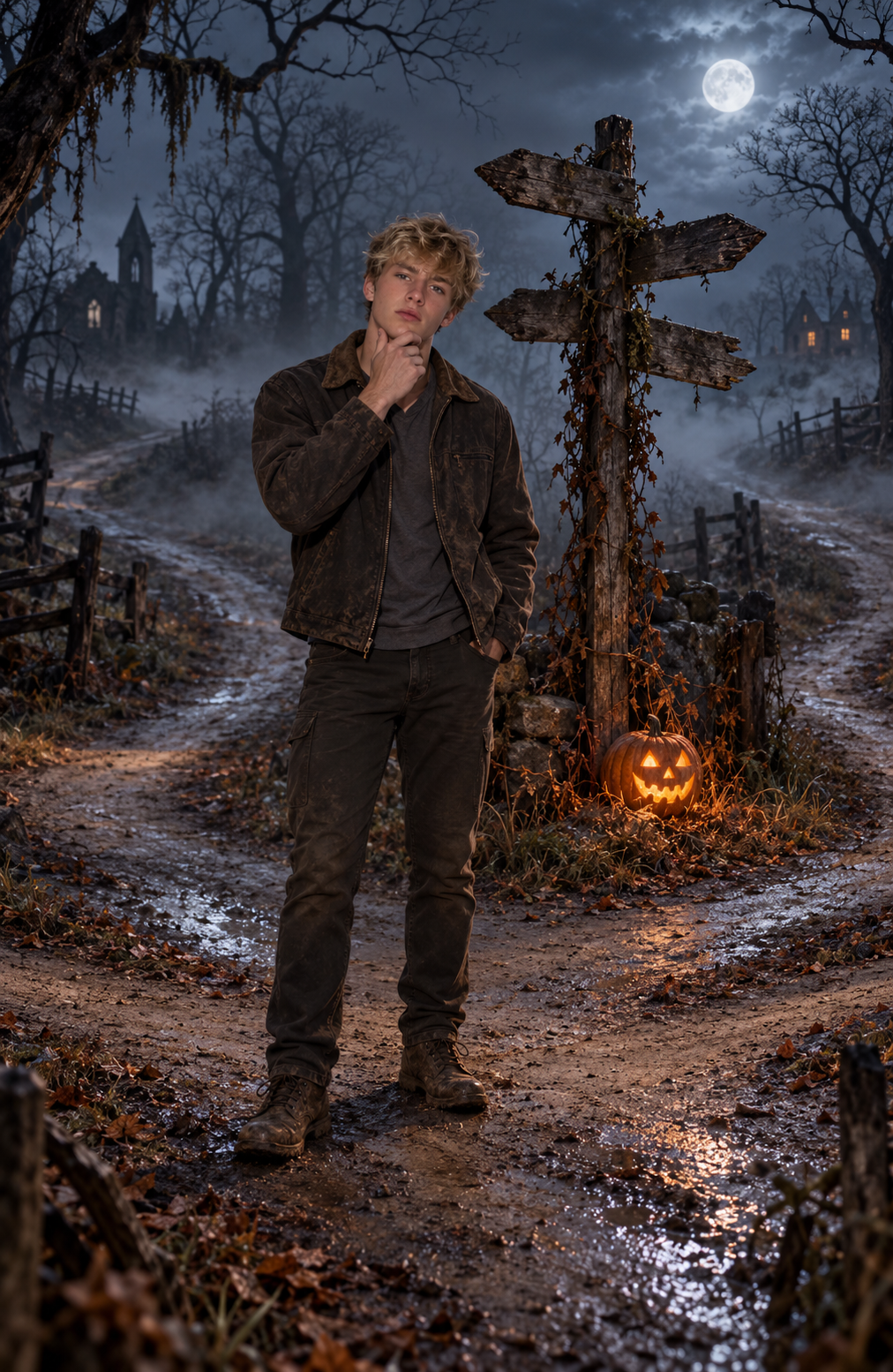 The Road Not Taken and the Room Not Opened The Road Not Taken and the Room Not Opened
Both symbols also depend upon curiosity. At the crossroads, we want to know where the other road leads. In the haunted house, we want to know what is behind the locked door. Horror depends upon this impulse. The intelligent decision is often obvious: Do not take the abandoned road. Do not enter the house. Do not open the basement. Do not investigate the noise. Do not read the diary. Yet if characters obeyed these rules, there would be no story. Curiosity moves horror forward. Halloween gives social permission to indulge that curiosity. We visit haunted houses because we want to enter the forbidden room without suffering permanent consequences. We tell crossroads legends because we want to imagine making the dangerous bargain while knowing we can return to ordinary life afterward.
The American Haunted Landscape
Together, these symbols reveal an important development in American horror. The United States gradually created its own haunted geography. European horror inherited castles and ancient ruins. American horror built its mythology around crossroads, covered bridges, plantation houses, abandoned farmhouses, Victorian mansions, highways, motels, suburban streets, cemeteries, forests, and small towns. The American ghost does not need an ancient castle. It can wait beside the highway. It can live in the attic. It can stand in the intersection. This localization is one reason Halloween became so deeply embedded in American culture. The supernatural is imagined not as distant but nearby. The haunted road may be outside town. The haunted house may be next door.
The Deeper Fear: The Past Is Still Here
At their deepest level, both the crossroads and haunted house concern the past. The crossroads contains previous travelers, old roads, forgotten choices, and stories about those who disappeared. The haunted house contains previous residents, inherited objects, old crimes, and memories embedded within architecture. Halloween allows the past to return. This does not need to be understood literally. Ghosts can represent memory. Haunting can represent guilt. The supernatural can represent history refusing erasure. The American haunted house is especially effective because American culture has frequently celebrated progress, reinvention, movement, and the possibility of beginning again. The haunted house rejects that optimism.
It says: You cannot always start over. The past lives here too. The crossroads delivers a similar warning. Choose whichever road you like. But every road comes from somewhere.
At the Center of the Crossroads
There is a reason these places continue appearing in Halloween imagination. The crossroads asks us to confront uncertainty. The haunted house asks us to confront memory. One looks forward. The other looks backward. Halloween stands between them. Every October, people deliberately place themselves within symbolic uncertainty. They walk through artificial cemeteries. They enter haunted attractions. They tell stories about lonely roads. They decorate homes as places of death and decay. They celebrate the possibility that boundaries may not be as firm as they seem. At the crossroads, we wonder what waits down the road. At the haunted house, we wonder what waits inside. Both fears depend upon something unseen. Perhaps nothing is there. Perhaps the strange figure at the intersection is only a traveler. Perhaps the noise upstairs is only old wood contracting in the cold. Perhaps the house has no memory. Perhaps no one waits at the crossroads.
But folklore begins with another possibility. Perhaps something does. That uncertainty is where Halloween lives. The holiday does not require us to believe in ghosts, demons, haunted houses, or supernatural crossroads. It asks only that we imagine them. For one night, the dark road may lead somewhere impossible. For one night, the abandoned house may not be empty. For one night, a person standing at the crossroads might hear footsteps approaching from a road no map remembers. And somewhere beyond the intersection, perhaps hidden behind dead trees and an iron gate, a house waits with one light burning in an upstairs window. The traveler has a choice.
Take the other road.
Or knock on the door.
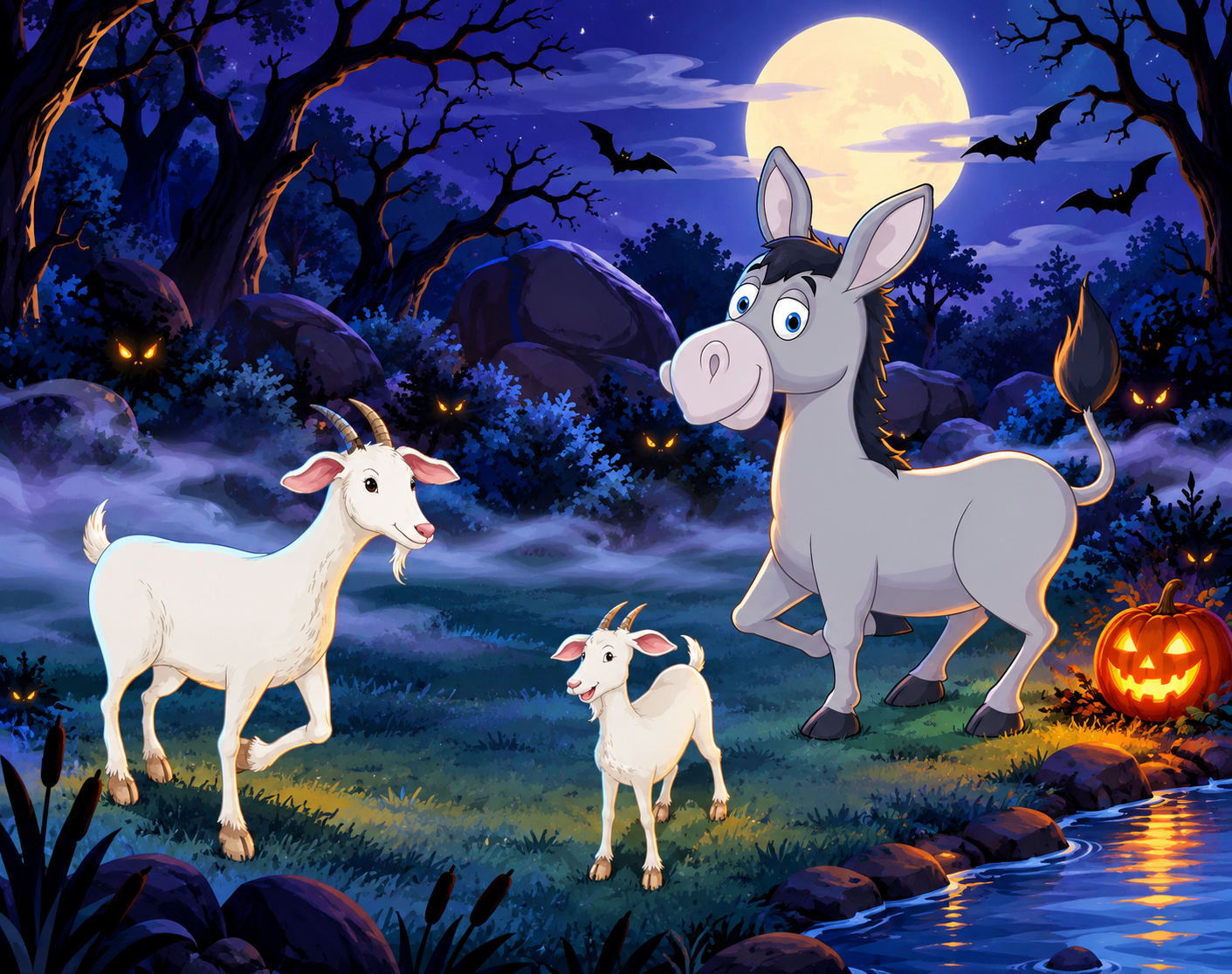
The images below are all AI-generated by me with ChatGPT, Grok, and Google Gemini on my iPhone. Enjoy!

The 31 Days of Halloween! Click on the day number you want! 01 | 02 | 03 | 04 | 05 | 06 | 07 | 08 | 09 | 10 | 11 | 12 | 13 | 14 | 15 | 16 | 17 | 18 | 19 | 20 | 21 | 22 | 23 | 24 | 25 | 26 | 27 | 28 | 29 | 30 | 31
George
|