Navigation:
Index
Splash Page |

 Two Goats and a Donkey! Two Goats and a Donkey!
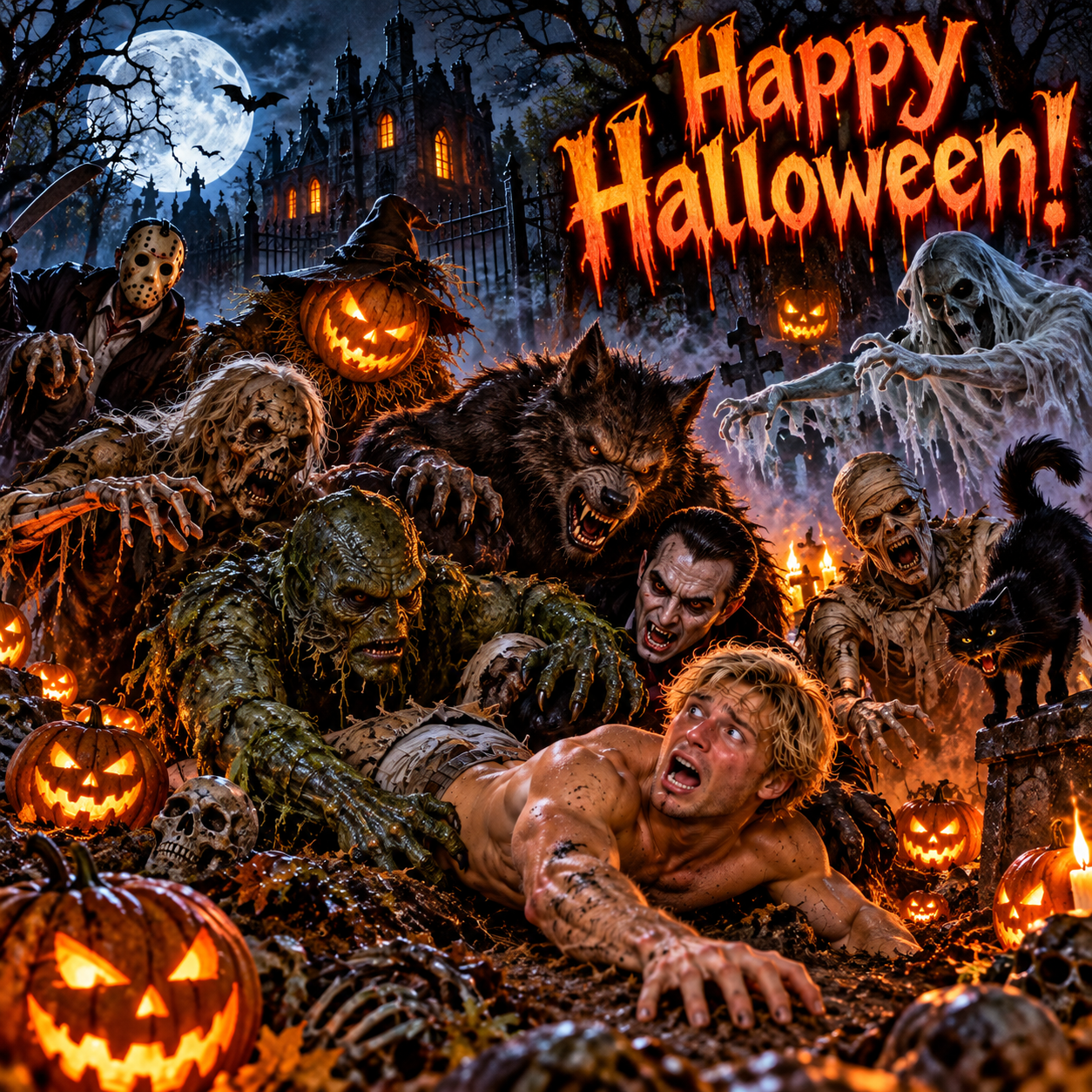
On The 31st Day of Halloween
Saturday, October 31, 2026
The Headless Horseman: From Ancient Folklore to an American Halloween Icon
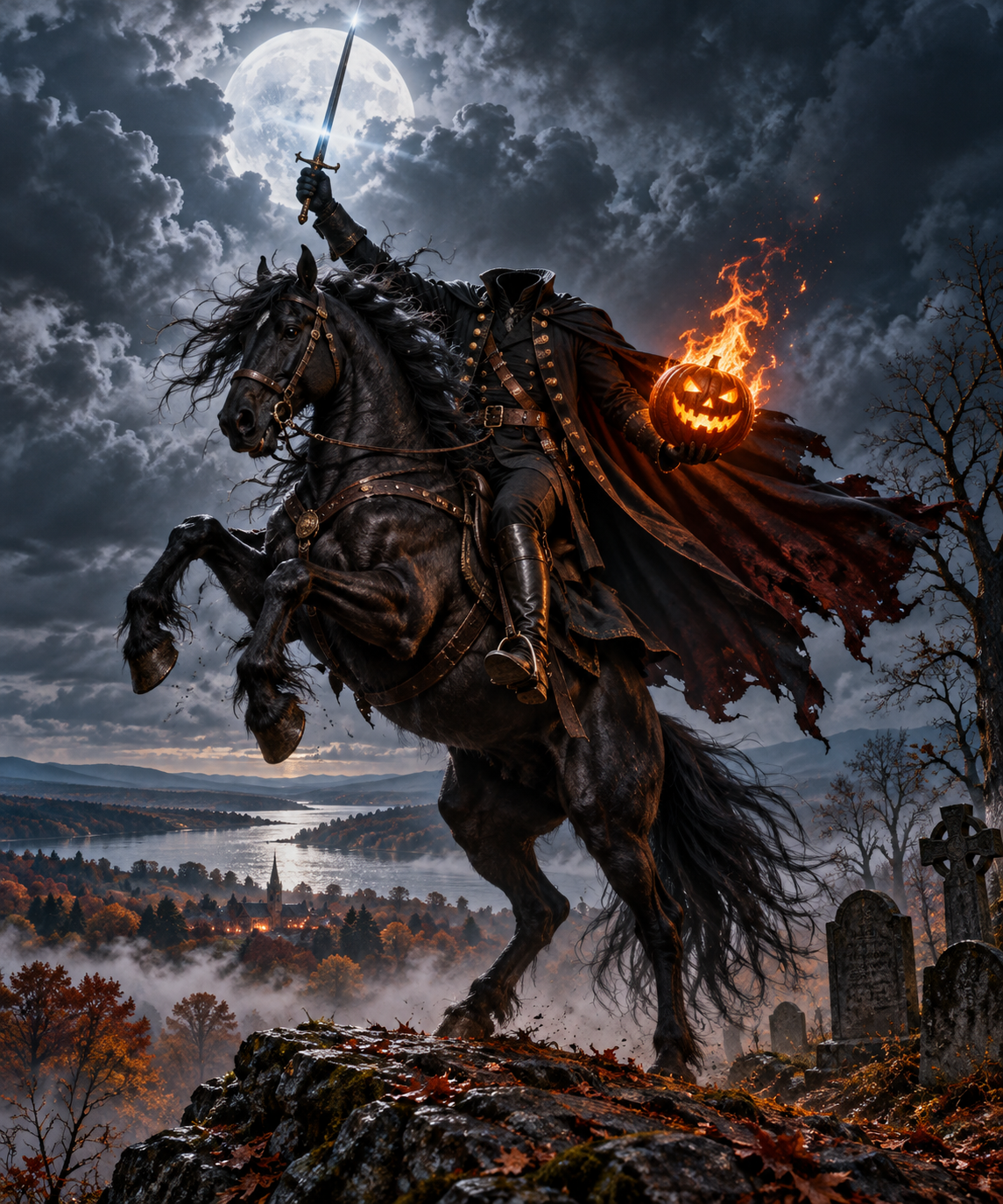 Few figures belong to the American Halloween imagination as completely as the Headless Horseman. A dark rider thunders along an isolated road beneath autumn trees, his cloak flying behind him and his missing head turning an ordinary horseman into something impossible. In many modern images he carries a glowing jack-o'-lantern where his head should be, and the combination seems so natural that it is easy to assume the Headless Horseman has always been connected with Halloween. Yet his history is more complicated. His familiar American identity comes primarily from Washington Irving's The Legend of Sleepy Hollow, first published in 1820 as part of The Sketch Book of Geoffrey Crayon, Gent., but Irving was drawing upon a much older European world of ghost riders, headless apparitions, phantom huntsmen, death omens, and supernatural beings who traveled lonely roads after dark. The Library of Congress describes Irving's story as one of the first works of American fiction to achieve popularity beyond the United States, an indication of how rapidly this strange rider escaped the Hudson Valley and entered a much larger cultural imagination.
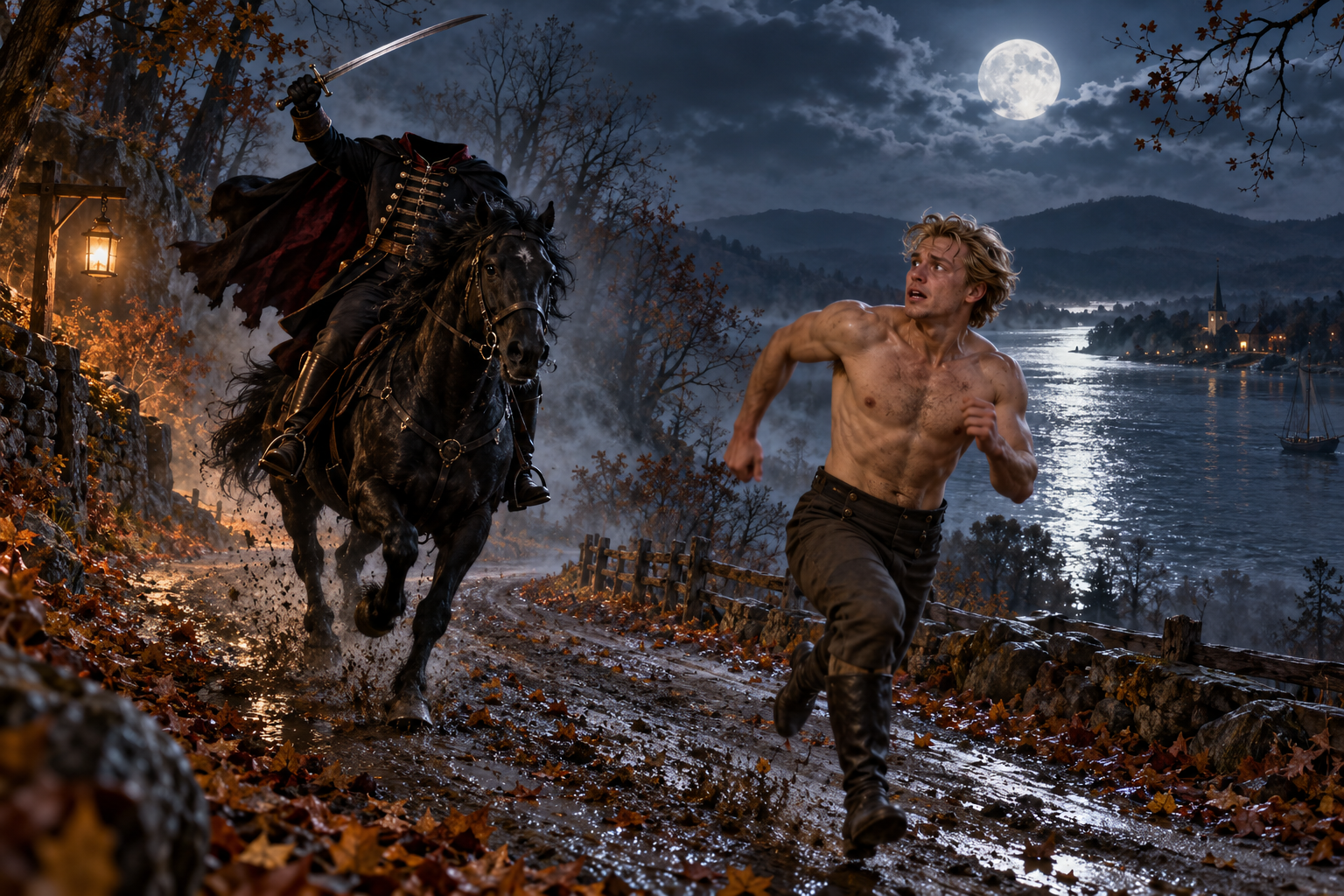 What makes the Headless Horseman especially effective is that he combines several fears into one figure. He is human but physically incomplete. He is dead yet still moving. He rides with tremendous speed but seems to have nowhere to go except back toward the place of his own death. He belongs to the past, yet he erupts violently into the present. Most importantly, the absence of his head removes the feature by which people recognize one another. He has no ordinary face, no visible eyes, and no expression. He is a person stripped of identity and transformed into pure pursuit. What makes the Headless Horseman especially effective is that he combines several fears into one figure. He is human but physically incomplete. He is dead yet still moving. He rides with tremendous speed but seems to have nowhere to go except back toward the place of his own death. He belongs to the past, yet he erupts violently into the present. Most importantly, the absence of his head removes the feature by which people recognize one another. He has no ordinary face, no visible eyes, and no expression. He is a person stripped of identity and transformed into pure pursuit.
Over two centuries after Irving's story appeared, the Horseman remains one of the few distinctly American literary ghosts who can stand alongside Dracula, Frankenstein's monster, witches, ghosts, skeletons, and werewolves as recognizable Halloween figures. His survival reveals how folklore evolves: an old supernatural motif traveled across cultures, entered American literature, absorbed the history of the Revolutionary War, and eventually became inseparable from pumpkins, autumn nights, haunted attractions, cartoons, films, and October itself.
Before Sleepy Hollow: The Fear of the Headless Dead
Washington Irving did not invent the idea of a headless ghost. Stories of headless apparitions existed in European folklore long before The Legend of Sleepy Hollow. The motif is powerful for an obvious reason: decapitation violates the basic shape of the human body. Death itself is frightening, but the headless dead appear especially unnatural because the part of the body most closely associated with identity has been removed. The human face allows recognition. The eyes appear to communicate thought and intention. The mouth speaks a name. Remove the head and a familiar body becomes anonymous. A headless ghost therefore represents not merely death but the destruction of recognizable personhood.
European traditions contained numerous headless spirits, headless riders, phantom hunters, and spectral processions. Some were believed to reenact violent deaths. Others appeared as omens. The supernatural rider was particularly frightening because horses dramatically increased the speed and power of the apparition. A ghost standing beside a road could be avoided. A ghost on horseback could pursue. Such stories flourished in cultures where nighttime travel could already be genuinely dangerous. Before modern lighting, a rural road after sunset was a world of limited visibility. Trees became figures. Hooves could be heard before riders were seen. Mist concealed distances. Travelers depended heavily upon moonlight, lanterns, and familiarity with the landscape. Folklore transformed these ordinary uncertainties into supernatural possibilities.
The Headless Horseman belongs naturally to this world.
The Irish Dullahan
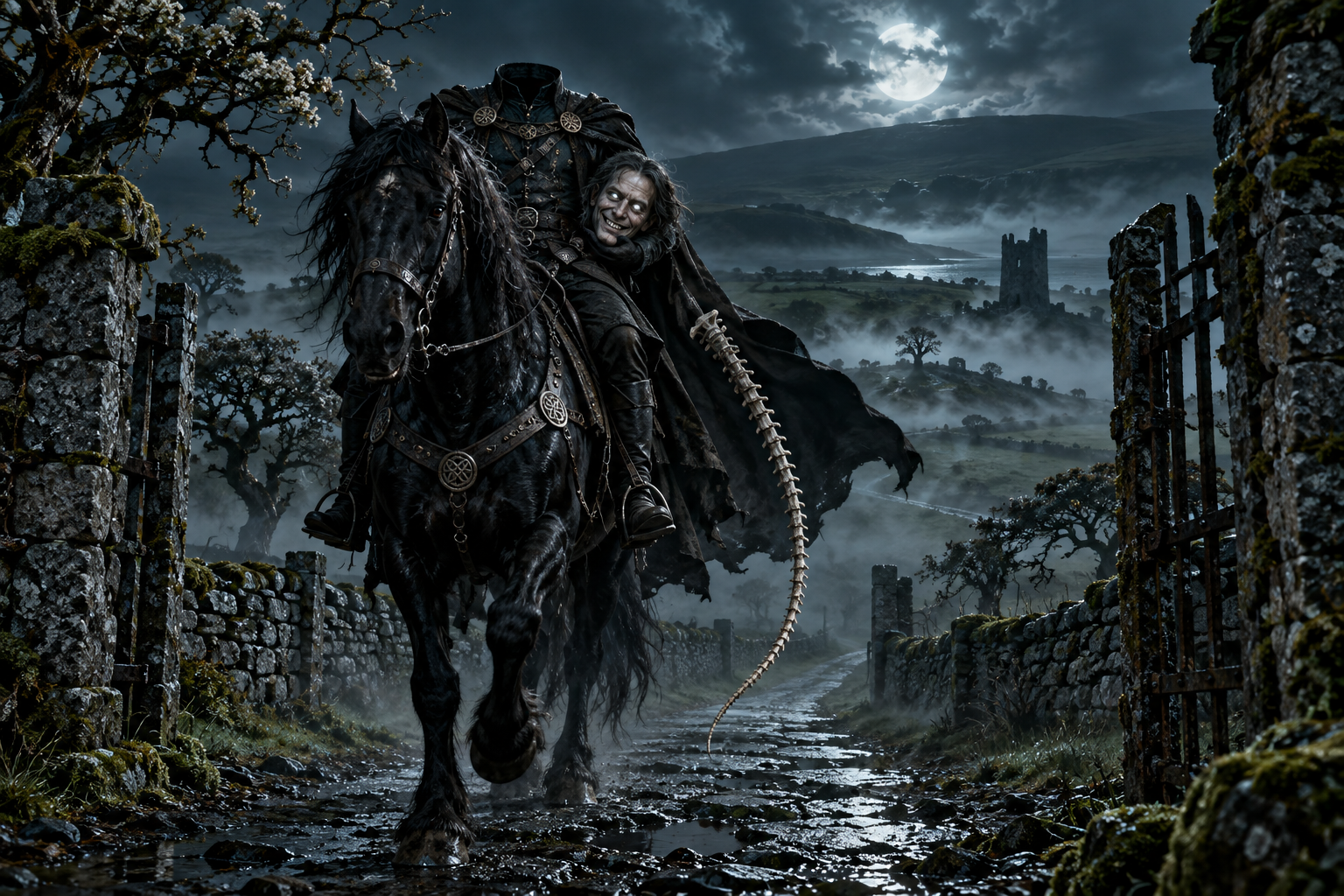 One of the figures most frequently compared with Irving's Horseman is the Irish Dullahan, a headless supernatural being associated with night travel, death, and sometimes a phantom coach. Nineteenth-century collections of Irish folklore describe headless riders capable of carrying their own heads. Thomas Crofton Croker's Fairy Legends and Traditions of the South of Ireland collected several traditions under the name Dullahan, including a tale explicitly titled “The Headless Horseman.” In one of Croker's stories, a rider's severed head is casually carried with him as though the impossible arrangement were perfectly natural. One of the figures most frequently compared with Irving's Horseman is the Irish Dullahan, a headless supernatural being associated with night travel, death, and sometimes a phantom coach. Nineteenth-century collections of Irish folklore describe headless riders capable of carrying their own heads. Thomas Crofton Croker's Fairy Legends and Traditions of the South of Ireland collected several traditions under the name Dullahan, including a tale explicitly titled “The Headless Horseman.” In one of Croker's stories, a rider's severed head is casually carried with him as though the impossible arrangement were perfectly natural.
Modern retellings often describe the Dullahan as a rider on a black horse who carries his head and functions as an omen of death. The broader Irish tradition also includes the *cóiste bodhar*, a mysterious death coach associated with fatal supernatural visitation. The similarity to Sleepy Hollow is obvious, and as a result the statement that Washington Irving “based the Headless Horseman on the Dullahan” is repeated frequently. The historical connection, however, should be treated cautiously. Irving's story appeared in 1820, while Croker's influential printed Dullahan collection appeared later in the 1820s. Irish oral traditions may certainly have existed before Croker recorded them, but proving that Irving specifically knew the Dullahan stories when writing *Sleepy Hollow* is another matter.
The safer conclusion is that Irving's Horseman belongs to a much wider European family of headless supernatural riders rather than being demonstrably copied from one specific Irish creature. This distinction does not diminish the Dullahan. On the contrary, comparing the two shows how widespread the image of the headless rider had become. Ireland had its headless riders and death coaches. German-speaking Europe had phantom huntsmen and spectral riders. Britain possessed tales of supernatural horses and headless apparitions. Irving inherited a cultural vocabulary in which encountering something impossible on a dark road was already a familiar form of supernatural storytelling.
German Folklore and the Wild Huntsman
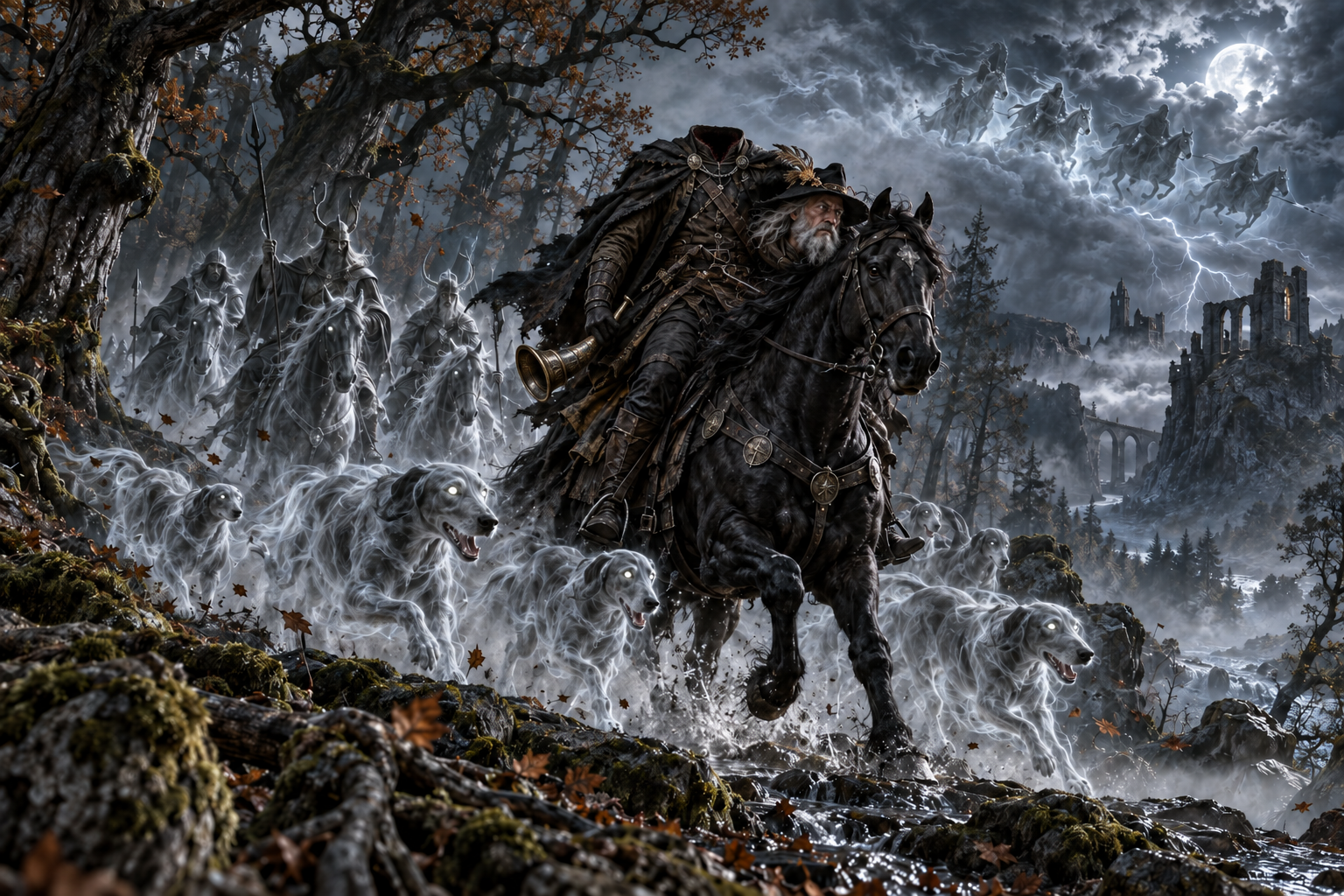 German folklore appears particularly important to understanding Irving's literary imagination. Irving was fascinated by European folktales and legends, and scholars have long compared Sleepy Hollow with German supernatural stories. One likely influence was the tradition of the Wild Huntsman, a cursed or supernatural rider who races eternally through the night. The Washington Irving Society has specifically discussed the possible influence of Sir Walter Scott's translation of Gottfried August Bürger's The Wild Huntsman, a poem in which an impious hunter is ultimately condemned to an endless supernatural pursuit. German folklore appears particularly important to understanding Irving's literary imagination. Irving was fascinated by European folktales and legends, and scholars have long compared Sleepy Hollow with German supernatural stories. One likely influence was the tradition of the Wild Huntsman, a cursed or supernatural rider who races eternally through the night. The Washington Irving Society has specifically discussed the possible influence of Sir Walter Scott's translation of Gottfried August Bürger's The Wild Huntsman, a poem in which an impious hunter is ultimately condemned to an endless supernatural pursuit.
Another German literary tradition involved a headless figure who could carry and throw his own head. A Library of Congress-hosted scholarly volume discussing fairy-tale film traces a striking headless figure to Johann Karl August Musäus's eighteenth-century tales of the mountain spirit Rübezahl. In that story a terrifying black figure appears without a head, carries it under his arm, and ultimately throws the head at a terrified driver. That last detail is especially interesting because Irving's Horseman does something remarkably memorable: during the climactic chase, he hurls what Ichabod believes to be his severed head. Later, the object is revealed — or at least strongly suggested — to have been a pumpkin. Irving therefore drew upon an Old World supernatural vocabulary but changed it into something unmistakably American.
Washington Irving and the Birth of an American Legend
 Washington Irving was born in New York City in 1783 and became one of the first American authors to achieve substantial international literary recognition. He was fascinated by the history, folklore, and cultural character of old New York, especially the Hudson River Valley and its Dutch colonial heritage. The Library of Congress notes that Irving frequently wrote about New York under its earlier Dutch settlers and that The Sketch Book of Geoffrey Crayon, published across 1819 and 1820, included both “Rip Van Winkle” and “The Legend of Sleepy Hollow.” Washington Irving was born in New York City in 1783 and became one of the first American authors to achieve substantial international literary recognition. He was fascinated by the history, folklore, and cultural character of old New York, especially the Hudson River Valley and its Dutch colonial heritage. The Library of Congress notes that Irving frequently wrote about New York under its earlier Dutch settlers and that The Sketch Book of Geoffrey Crayon, published across 1819 and 1820, included both “Rip Van Winkle” and “The Legend of Sleepy Hollow.”
Irving did something extremely important for the young United States. European countries possessed ancient castles, medieval legends, ruined abbeys, old ghosts, and centuries of traditional folklore. The United States seemed comparatively young to many early nineteenth-century writers. Irving effectively demonstrated that America could create legends of its own by blending European storytelling traditions with American geography and history. Sleepy Hollow was the perfect setting. Irving describes an isolated valley near Tarry Town, New York, as a place seemingly under enchantment. Its residents tell ghost stories, remember supernatural encounters, and inhabit a landscape in which imagination appears almost contagious. In Irving's description, even newcomers eventually begin dreaming dreams and seeing apparitions after living there long enough.
The landscape itself therefore becomes haunted before the Horseman even appears.
The Hessian Soldier
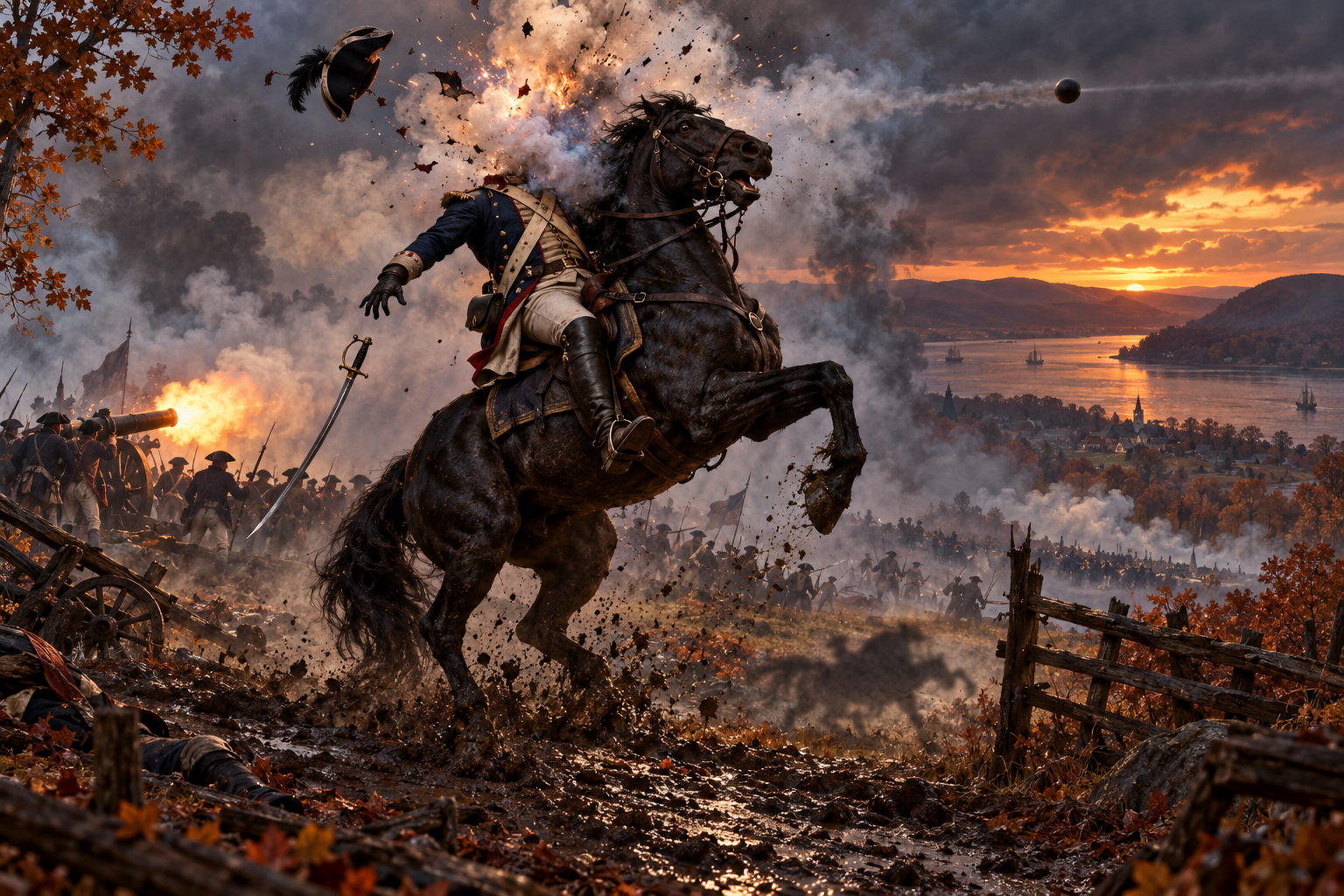 Irving gave his ghost a specifically American historical identity. The Headless Horseman was said to be the ghost of a Hessian trooper killed during the American Revolution when a cannonball carried away his head. His body was supposedly buried in the local churchyard, and his spirit rode through the Hollow at night searching for the missing head. Irving explains that the apparition's tremendous speed resulted partly from his need to return to the cemetery before daylight. Irving gave his ghost a specifically American historical identity. The Headless Horseman was said to be the ghost of a Hessian trooper killed during the American Revolution when a cannonball carried away his head. His body was supposedly buried in the local churchyard, and his spirit rode through the Hollow at night searching for the missing head. Irving explains that the apparition's tremendous speed resulted partly from his need to return to the cemetery before daylight.
The reference to a Hessian would have been immediately connected with Revolutionary history. German troops served with British forces during the American Revolution; the term “Hessian” became an American shorthand for these German auxiliaries, although they came from several German states. The National Park Service documents the presence of soldiers from Hesse-Cassel in the New York campaigns beginning in 1776.
Irving therefore took the European supernatural rider and gave him an American war wound. That transformation is central to the story's power. The Horseman is not simply a random medieval ghost imported into New York. He represents unfinished history. The Revolutionary War is over, but one of its dead soldiers continues riding. The new republic is literally haunted by its past.
Ichabod Crane
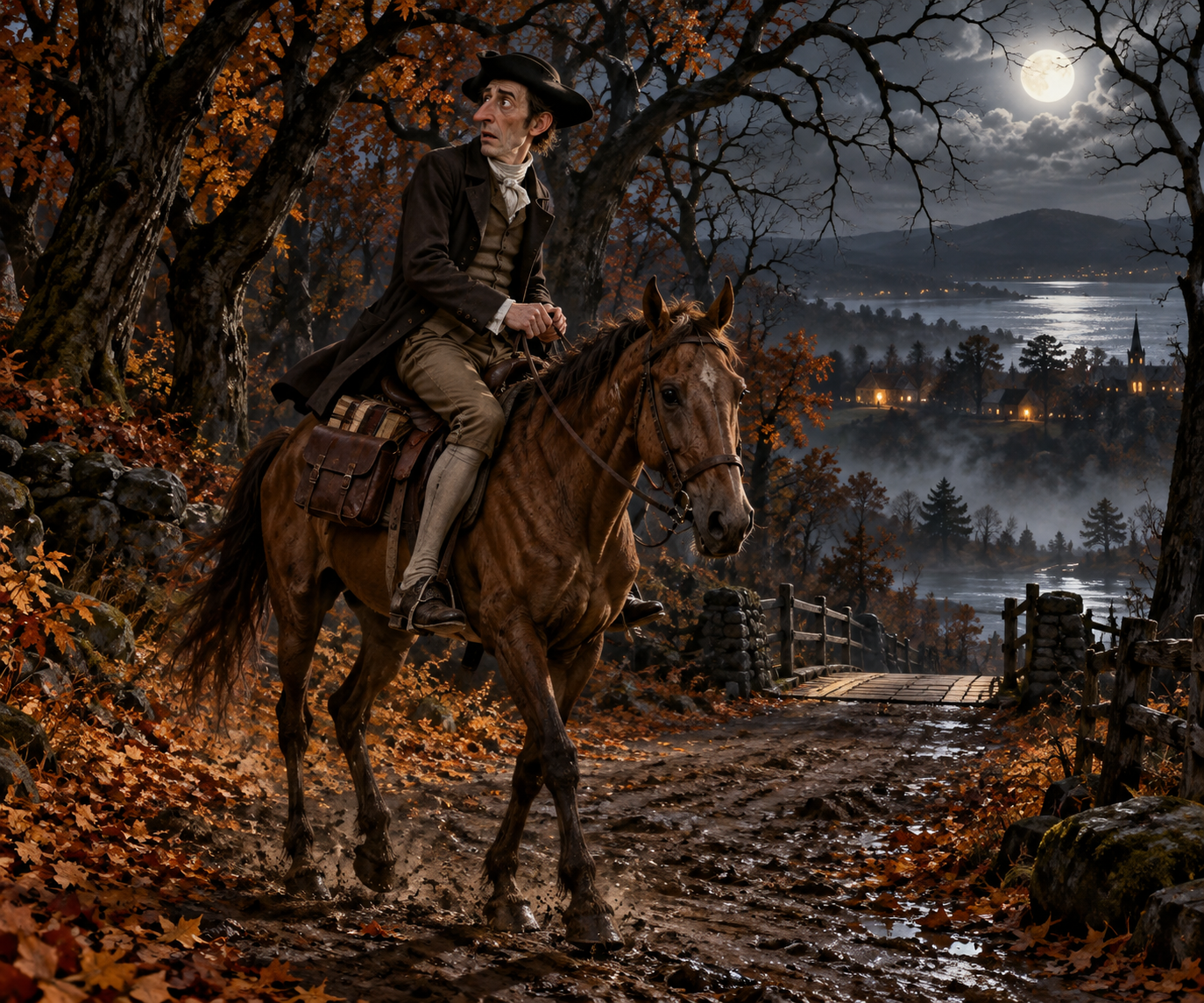 The Horseman would never have become such an effective monster without the perfect victim. The Horseman would never have become such an effective monster without the perfect victim.
Ichabod Crane is one of American literature's great comic creations. He is a schoolmaster, educated enough to consider himself intellectually superior to many of the rural people around him yet remarkably susceptible to superstition. He enjoys frightening stories even though they terrify him afterward. His appearance is almost designed to contrast with the Horseman. Ichabod is thin, awkward, elongated, and physically unimpressive.
The Horseman is powerful, mounted, dark, and relentless. Ichabod also possesses a voracious appetite. His romantic interest in Katrina Van Tassel is repeatedly entangled with his fascination with her father's prosperous farm and the food it could provide. Irving's comedy therefore makes Ichabod simultaneously sympathetic and ridiculous.
Most importantly, Ichabod already believes in ghosts. When the Horseman finally appears, the legend does not have to convince him. He has spent the evening listening to supernatural stories, including tales about the Headless Horseman. His imagination is prepared for terror. That is one of Irving's cleverest devices. The monster begins pursuing Ichabod before the physical rider ever appears. The first Horseman is the one created inside Ichabod's mind.
Brom Bones
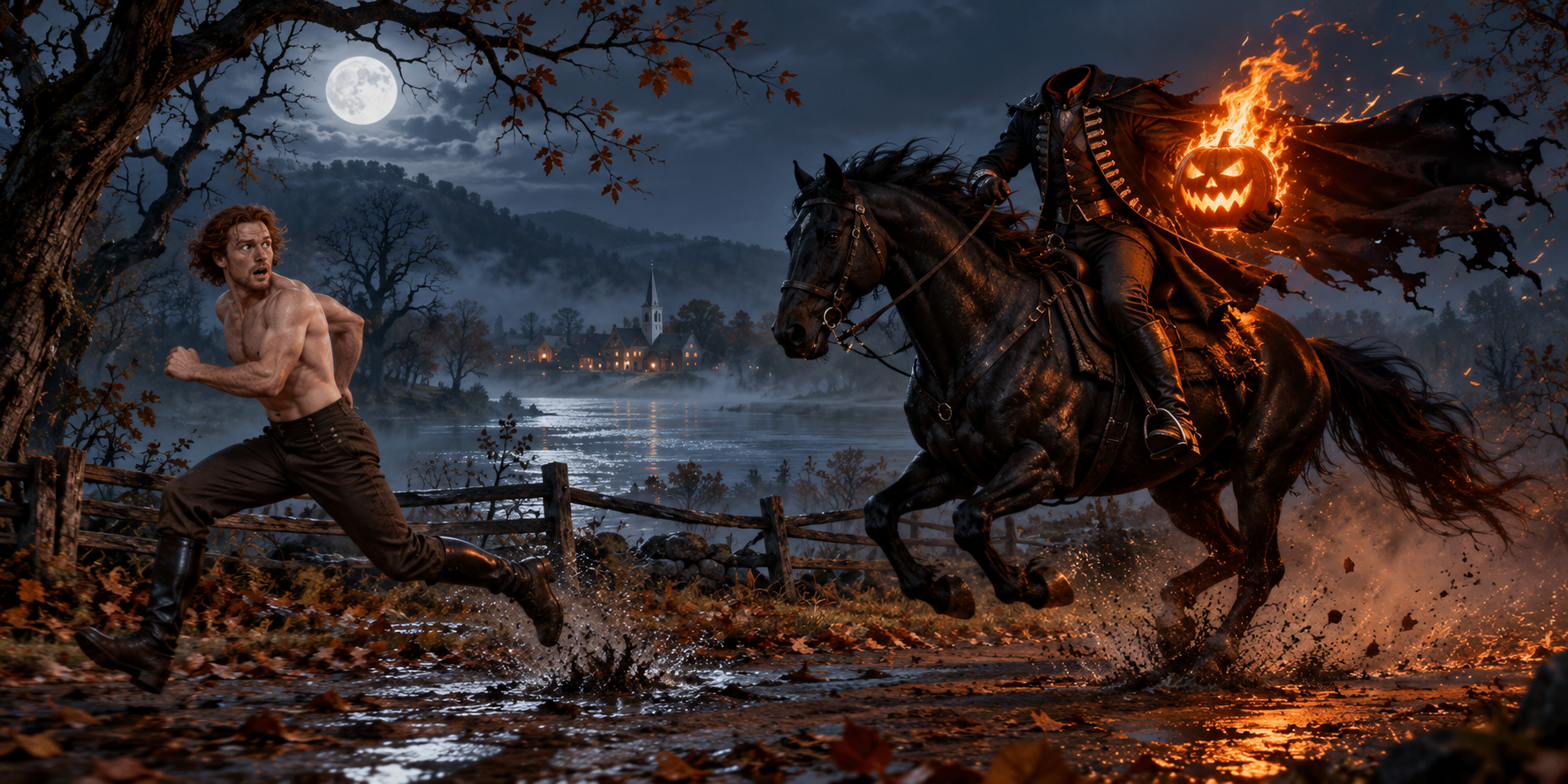
Standing opposite Ichabod is Abraham “Brom Bones” Van Brunt, his rival for Katrina's affection. Brom is everything Ichabod is not: physically powerful, confident, athletic, practical, and deeply fond of jokes and mischief. He also knows the local legends. This becomes critically important. After Ichabod leaves the Van Tassel gathering and encounters the supposed Headless Horseman, he is pursued toward the bridge where tradition claims the apparition should vanish. Instead, the mysterious rider rises in the saddle and throws his “head” directly at Ichabod.
Ichabod is knocked from his horse. By morning he has disappeared. Searchers discover his wandering horse, his abandoned belongings, and a shattered pumpkin near the scene. Brom's later reaction strongly suggests that he knows considerably more about the event than he admits. The implication is that Brom may have disguised himself as the Headless Horseman, chased his superstitious rival through the night, and thrown a pumpkin at him. Yet Irving never completely closes the supernatural door. That uncertainty is essential.
Was the Headless Horseman Real?
This question has preserved the story for more than two centuries. The rational explanation is straightforward. Brom Bones knew Ichabod feared the Horseman. Brom had motive to remove a romantic rival. Brom was an excellent horseman and famous practical joker. A smashed pumpkin was found after the attack. Brom later appears amused when the circumstances of Ichabod's disappearance are discussed.
Case closed.
Or perhaps not.
Irving's narrator is unreliable enough, the atmosphere strange enough, and the Hollow supernatural enough that complete certainty remains elusive. An Oxford Academic discussion of the story emphasizes how Irving continually gives readers reasons to doubt appearances and even the narrative itself.
This ambiguity is one of the great secrets of effective ghost stories. A ghost that is definitively proven real belongs to fantasy. A ghost definitively proven fake belongs to a mystery. A ghost that might have been real continues haunting the reader. Irving leaves us in that third category.
The Pumpkin and the Missing Head
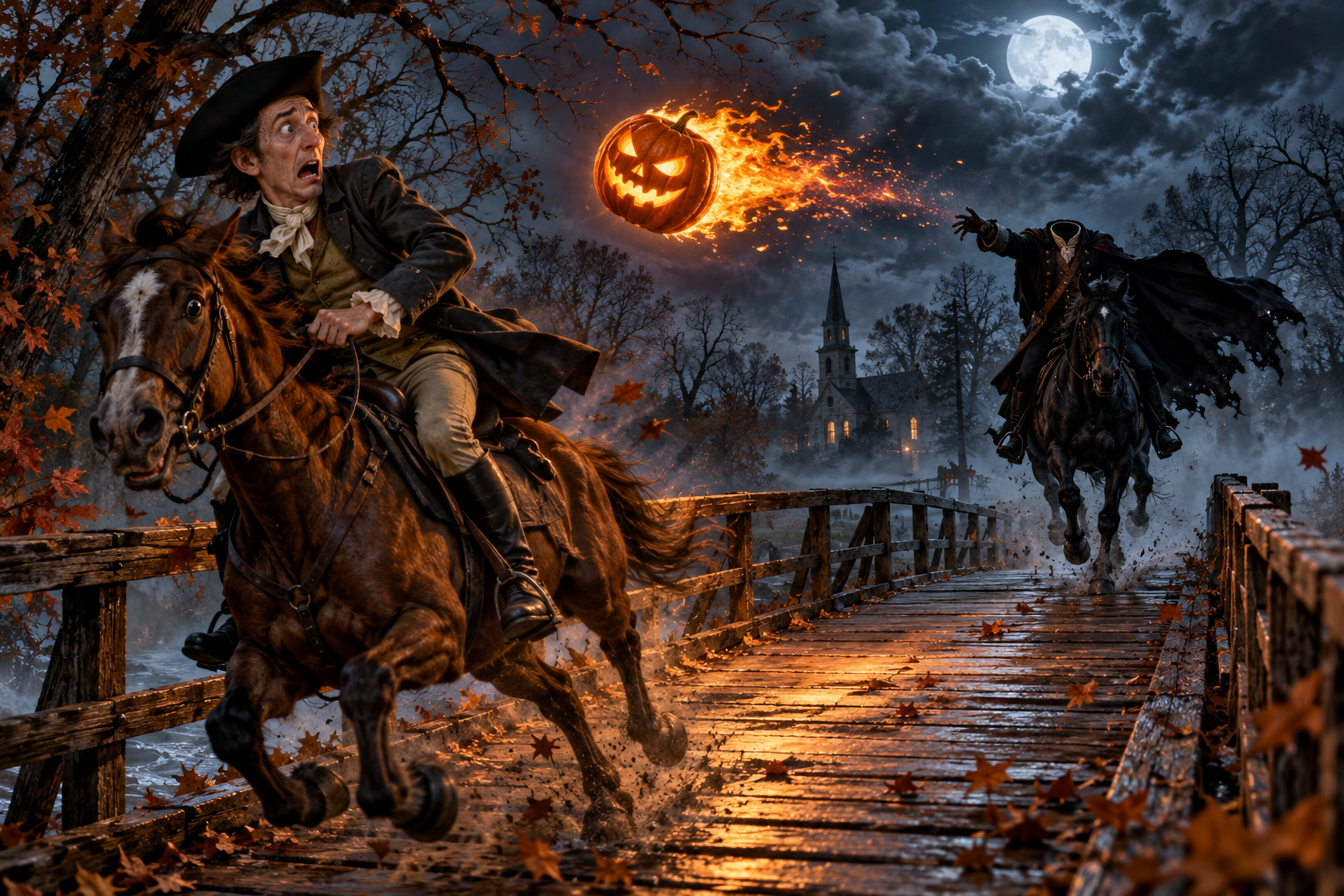 Perhaps no element contributed more to the Horseman's eventual Halloween identity than the pumpkin. In Irving's story, the pumpkin is probably the explanation for the supposed severed head that strikes Ichabod. Yet later visual culture gradually fused the two objects together. The pumpkin stopped being evidence against the supernatural. It became part of the supernatural. Perhaps no element contributed more to the Horseman's eventual Halloween identity than the pumpkin. In Irving's story, the pumpkin is probably the explanation for the supposed severed head that strikes Ichabod. Yet later visual culture gradually fused the two objects together. The pumpkin stopped being evidence against the supernatural. It became part of the supernatural.
Illustrators, films, cartoons, Halloween decorations, and haunted attractions increasingly imagined the Headless Horseman carrying a jack-o'-lantern as though it were his substitute head. This development is fascinating because Irving never needed the pumpkin to be a glowing carved jack-o'-lantern. The later Halloween imagination completed that transformation. Two separate traditions merged: the Headless Horseman and the jack-o'-lantern. Once combined, they seemed destined for each other. The jack-o'-lantern possesses a face without a body. The Horseman possesses a body without a face. Together they form a complete Halloween monster.
Why Headlessness Is So Frightening
The Horseman also touches a deeper psychological fear. The head represents identity. Portraits concentrate upon the face because human beings instinctively search faces for recognition and emotion. We identify people by their eyes, mouths, expressions, and voices. The Headless Horseman has none. He cannot be read. A masked killer still has a face somewhere underneath the mask. The Horseman apparently has nothing. Headlessness also creates a contradiction between death and motion. A decapitated human being cannot ride a horse. Yet the Horseman gallops with extraordinary power. His very existence therefore announces that ordinary physical rules no longer apply. This is one reason he remains frightening even when depicted without gore. He does not require blood or exposed wounds. His silhouette alone communicates impossibility.
A rider.
A horse.
A cloak.
Broad shoulders.
And nothing above them.
The Bridge and the Threshold
The bridge in *The Legend of Sleepy Hollow* is almost as important as the Horseman himself. Folklore repeatedly places supernatural encounters at boundaries: crossroads, gates, bridges, shorelines, forest edges, doorways, and twilight. Such places are liminal, meaning that they exist between one state and another.
A bridge is especially powerful because it literally connects separate territories. Ichabod believes that reaching the bridge may save him because local stories claim the Horseman cannot pass beyond a particular point. He therefore races toward a boundary between danger and safety.
This makes the chase more than a physical pursuit. It becomes a ritual crossing. If Ichabod can cross, ordinary reality may return. Instead the Horseman attacks precisely at that threshold. Halloween operates according to the same symbolism. October 31 occupies a cultural boundary between autumn abundance and approaching winter, daylight and darkness, ordinary life and temporary masquerade. The bridge and Halloween therefore speak the same imaginative language. Both ask what may cross when boundaries weaken.
The Horseman and the American Landscape
Another reason Irving's story became so influential is that it demonstrated that American landscapes could be haunted. European Gothic literature possessed castles, monasteries, crypts, and ancient ruins. Irving offered something different: a country road. Trees. A bridge. A churchyard. A quiet valley. That decision helped establish an American form of Gothic storytelling.
The terrifying location did not need to be a ruined medieval castle. It could be just beyond the farmhouse. This idea would become enormously important in American horror. Haunted woods, lonely rural roads, covered bridges, abandoned barns, cornfields, cemeteries, and small towns would eventually become some of the genre's most familiar landscapes.
Sleepy Hollow helped teach America that home could be haunted too.
From Literature to Halloween
Interestingly, The Legend of Sleepy Hollow is not explicitly a modern Halloween story. Irving's tale is strongly autumnal, filled with harvest imagery, storytelling, nighttime travel, ghosts, and pumpkins, but it predates the fully developed American Halloween culture of modern trick-or-treating, mass-produced costumes, suburban decorations, and commercial haunted houses. Nevertheless, almost everything the later Halloween imagination needed was already there. Autumn leaves. Pumpkins. Ghost stories. Dark roads. A cemetery. A supernatural rider. A fearful journey home. The boundary between joke and genuine haunting.
As American Halloween grew during the nineteenth and twentieth centuries, *Sleepy Hollow* increasingly migrated into the holiday. The fit was nearly perfect.
The Library of Congress notes that the story's imagery of the Horseman's supernatural pursuit sustained its popularity through repeated editions and adaptations in film, theater, music, and other media. Eventually, the Headless Horseman stopped belonging only to Washington Irving. He belonged to October.
Disney and the Horseman's Modern Appearance
For many twentieth-century Americans, one of the most influential versions arrived through Walt Disney's animated adaptation, released as part of The Adventures of Ichabod and Mr. Toad in 1949. The animated Horseman helped crystallize several visual elements that modern audiences immediately recognize: the flowing cape, dark horse, wild pursuit, supernatural laughter, and blazing pumpkin hurled at Ichabod. Animation could make the chase faster and more fantastic than an ordinary live-action production. The Horseman could become enormous, theatrical, and nearly elemental. That version also reached children. This mattered enormously.
The Headless Horseman entered the same cultural space occupied by Halloween itself: frightening, but safely frightening. Children could experience genuine suspense while understanding that they were inside an entertaining story. Fear became fun.
A Darker Horseman
Later adaptations pushed the character toward horror. Tim Burton's 1999 film Sleepy Hollow dramatically reinvented Irving's story, turning the Horseman into a genuinely supernatural killer within a Gothic murder mystery. The basic ingredients remained recognizable — Ichabod Crane, Sleepy Hollow, the Hessian Horseman, the bridge, decapitation — but the gentle ambiguity and satire of Irving's story gave way to explicit supernatural horror. The enduring flexibility of the original is demonstrated by the enormous range of adaptations it has inspired, from animation and children's retellings to films, musicals, graphic novels, and darker horror interpretations.
This ability to change is another reason the Horseman survives. He can be funny. He can be terrifying. He can frighten children. He can inhabit adult horror. He can be a real ghost. He can be a prank. He can carry a pumpkin. He can search for his own head. The essential image survives every transformation.
The Headless Horseman as a Halloween Symbol
The Horseman now occupies a distinctive place among Halloween monsters. The vampire represents forbidden immortality and predatory desire. The werewolf represents transformation and loss of control. The ghost represents the persistence of the dead. The witch represents magic and forbidden power. The zombie represents the body continuing after the self has vanished. The Headless Horseman represents something slightly different. He represents unfinished death.
Something has been taken from him, and he continues moving because the loss has never been resolved. His ride has no true destination. He searches. He pursues. He returns. That repetition makes him a perfect ghost. Ghost stories often depend upon unfinished business: an unavenged murder, an unburied body, a broken promise, a lost love, an unmarked grave. The Horseman's missing head is unfinished business made physically visible. He cannot rest because he is incomplete.
Why He Still Rides
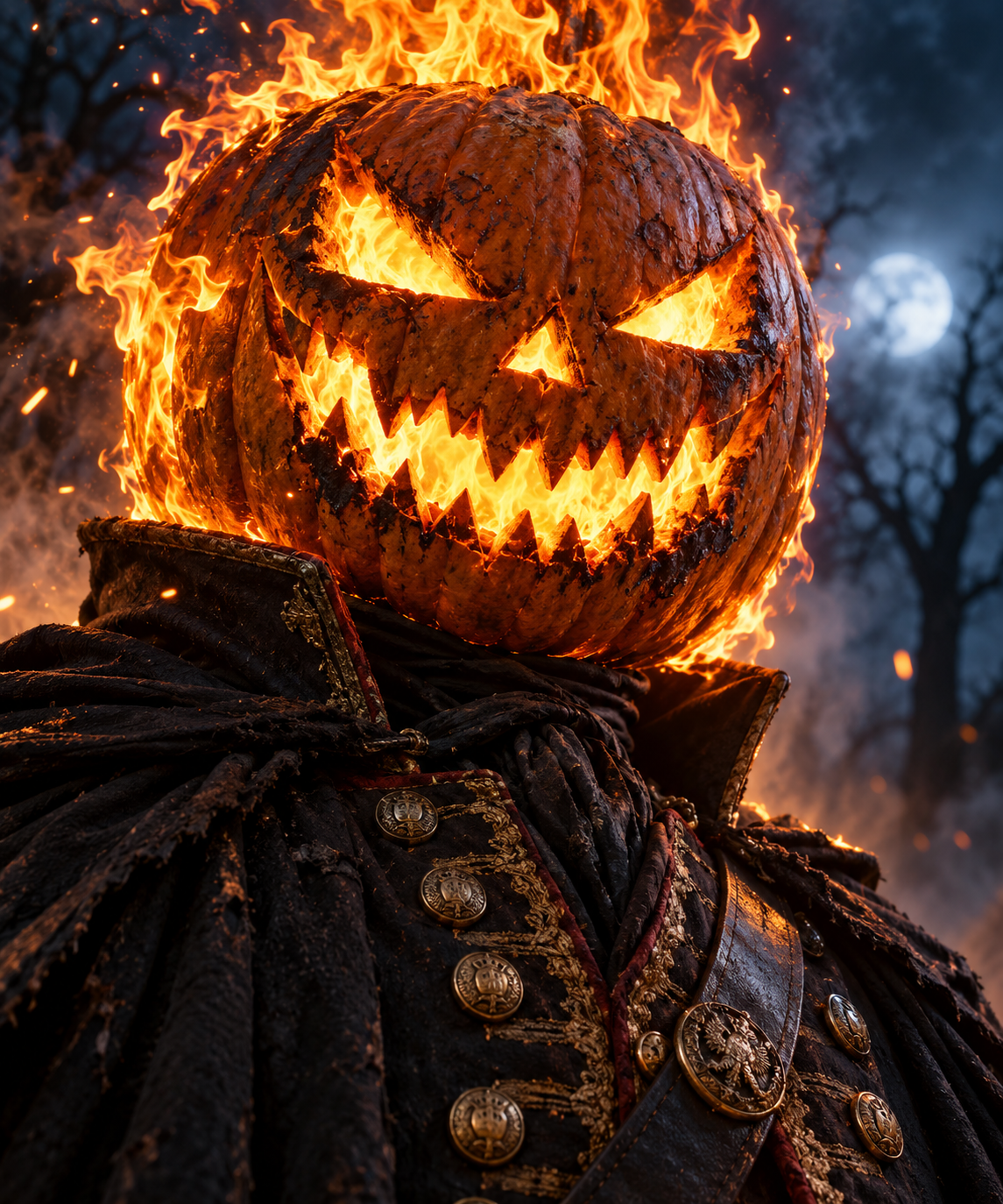 More than two hundred years after Washington Irving published The Legend of Sleepy Hollow, the Headless Horseman continues galloping through American culture because he belongs simultaneously to history, folklore, literature, and Halloween. He carries traces of older European supernatural traditions: headless apparitions, phantom riders, death omens, and wild huntsmen. He resembles Ireland's Dullahan without being reducible to it. He echoes German supernatural storytelling and the frightening riders of European folklore. Irving then placed this ancient type of apparition within the aftermath of the American Revolution and transformed him into a Hessian soldier eternally searching for the head taken from him by war. More than two hundred years after Washington Irving published The Legend of Sleepy Hollow, the Headless Horseman continues galloping through American culture because he belongs simultaneously to history, folklore, literature, and Halloween. He carries traces of older European supernatural traditions: headless apparitions, phantom riders, death omens, and wild huntsmen. He resembles Ireland's Dullahan without being reducible to it. He echoes German supernatural storytelling and the frightening riders of European folklore. Irving then placed this ancient type of apparition within the aftermath of the American Revolution and transformed him into a Hessian soldier eternally searching for the head taken from him by war.
Then American culture transformed him again. The pumpkin became a jack-o'-lantern. The autumn setting became Halloween. The local ghost became a national monster. Yet perhaps the most remarkable feature of the Horseman remains Irving's refusal to explain him completely. Maybe Brom Bones created the entire apparition. Maybe Ichabod's superstition turned an ordinary prank into supernatural terror. Maybe Sleepy Hollow really is haunted. The Headless Horseman lives in the space between those possibilities. That uncertainty is precisely where Halloween itself thrives.
Halloween asks us to pretend that the ordinary world may not be quite as ordinary as it appears. A scarecrow might move after dark. A cemetery might contain more than graves. A shadow beside the road might not be a tree. Hoofbeats heard in the distance might belong to an ordinary rider. Or perhaps they do not. That possibility transforms an empty road into a haunted one. It transforms a pumpkin into a face. It transforms an old story into a legend. And somewhere in the autumn darkness, beyond the last light of the village, the road curves toward a bridge.
The leaves move in the wind.
A horse begins to gallop.
The rider has no head.
And after more than two centuries, he is still coming.

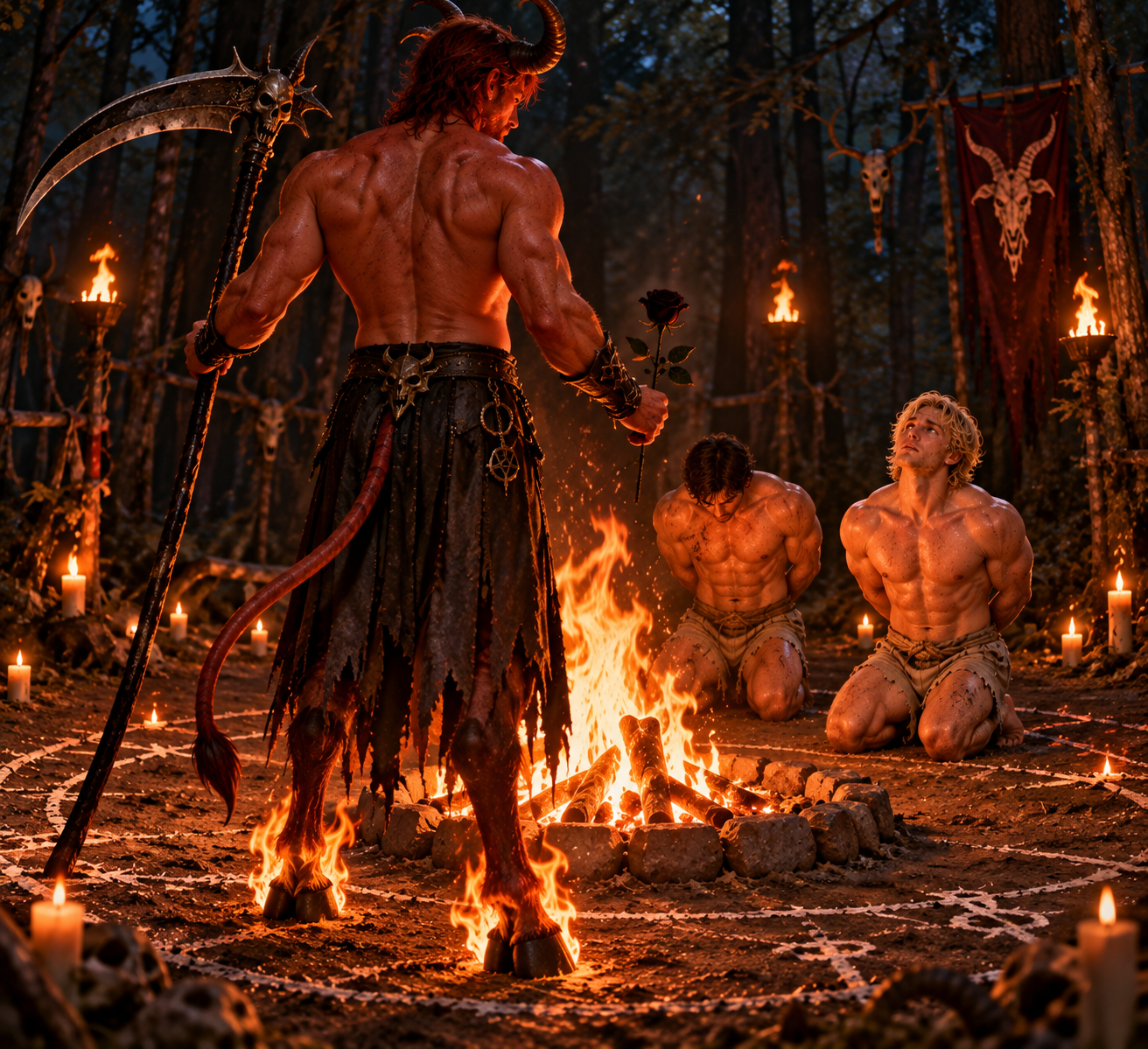
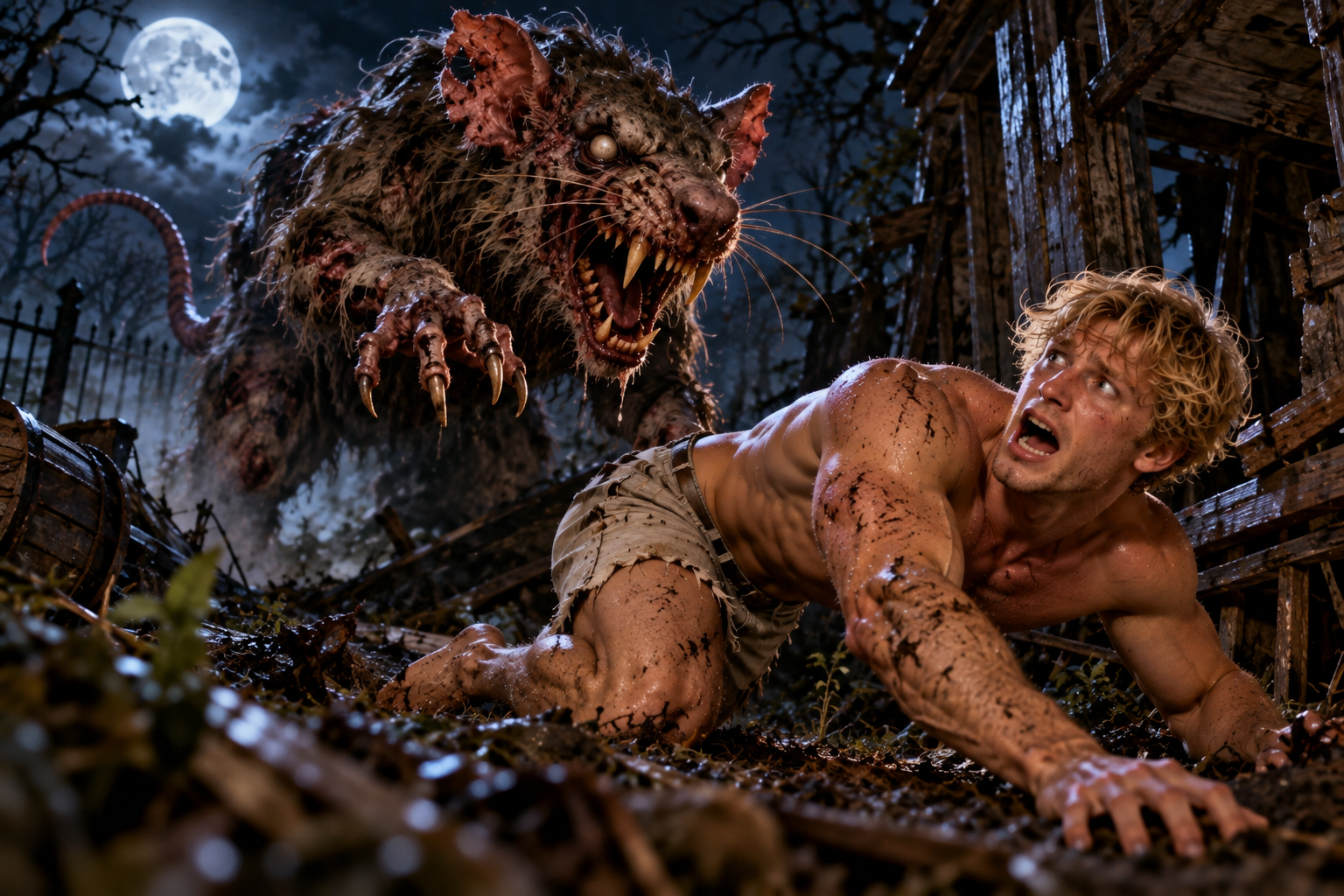
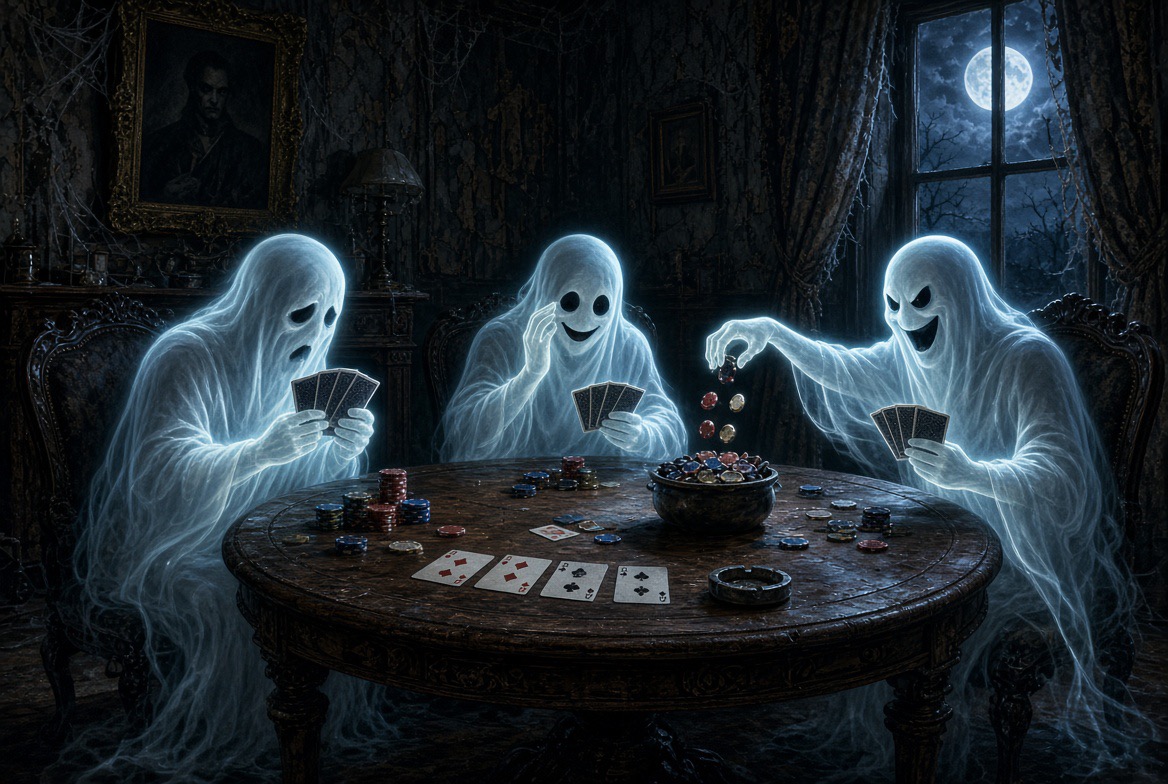
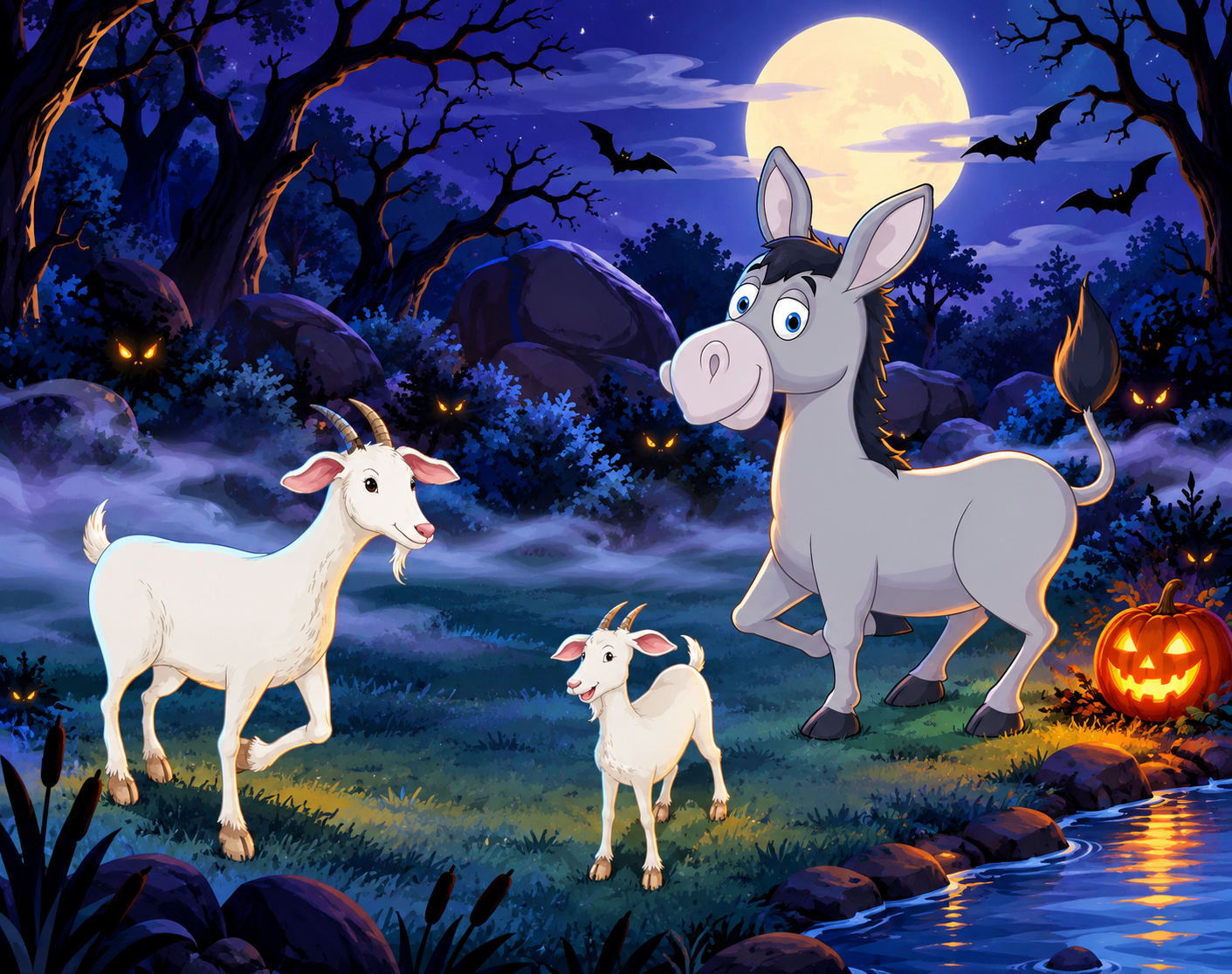
The images below are all AI-generated by me with ChatGPT, Grok, and Google Gemini on my iPhone. Enjoy!
The 31 Days of Halloween! Click on the day number you want! 01 | 02 | 03 | 04 | 05 | 06 | 07 | 08 | 09 | 10 | 11 | 12 | 13 | 14 | 15 | 16 | 17 | 18 | 19 | 20 | 21 | 22 | 23 | 24 | 25 | 26 | 27 | 28 | 29 | 30 | 31
George
|