Navigation:
Index
Splash Page |

 Two Goats and a Donkey! Two Goats and a Donkey!
On The 28th Day of Halloween
Wednesday, October 28, 2026
Since I've used so many AI images of centaurs in these 31 Days of Halloween pages, I felt an article on centaurs would be appropriate.
Centaurs: Origins, History, Mythology, Lore, and Queer Interpretation
Few creatures of classical mythology are as immediately recognizable as the centaur. From the waist upward he is human, usually male, while below he possesses the body and four legs of a horse. The image is so familiar that it can be easy to overlook how strange the creature actually is. A centaur combines the reasoning mind, hands, speech, face, and emotions of a human being with the strength, speed, sexuality, and instinct traditionally associated with the horse. Ancient Greek artists and storytellers repeatedly exploited this contradiction. Centaurs could be savage or civilized, violent or compassionate, lustful or disciplined, drunken or wise. In one story they attack a wedding party in a frenzy of alcohol and sexual aggression; in another, the noble centaur Chiron educates some of the greatest heroes Greece would ever know.
Because of this duality, centaurs became far more than imaginary monsters. They were instruments through which ancient people could think about civilization and instinct, masculinity and sexuality, self-control and appetite, humanity and animality. Their mythology survived Greece and Rome, entered medieval bestiaries and Renaissance art, and eventually became part of modern fantasy literature, film, games, queer art, and popular culture. Even today, the centaur remains compelling because his body permanently occupies a boundary. He is neither fully man nor fully beast, yet he is also unmistakably both.
Origins of the Centaur
The precise origin of the centaur is difficult to reconstruct. Composite beings combining human and animal characteristics existed throughout the ancient Mediterranean and Near East, and Greek culture developed in constant contact with civilizations that possessed their own hybrid monsters. Greek art of the Geometric and Archaic periods increasingly displayed composite creatures, and scholars have noted that Greek artists were influenced by Egyptian and Near Eastern artistic traditions. Centaurs became clearly identifiable in Greek art during the early first millennium BCE, while their familiar anatomical form became increasingly standardized during the seventh and sixth centuries BCE. Early artists sometimes depicted a complete human body with a horse's hindquarters attached behind it; later artists favored the now-familiar form in which a human torso rises from the place where a horse's neck would normally begin.
One old explanation for the legend suggested that people unfamiliar with horseback riding might have seen mounted horsemen from a distance and imagined horse and rider as a single creature. It is an appealing story, but it remains speculative rather than established fact. The centaur probably developed through a much more complicated interaction of mythology, artistic experimentation, horse culture, and the Greek fascination with creatures that blurred categories.
The Greek name, *Kentauros*, also has no universally accepted explanation. Ancient and later writers proposed various etymologies, but none provides a certain answer. What is clearer is the geographical association. Centaurs were especially connected with Thessaly in northern Greece, a region famous in antiquity for horses and horsemanship. Their legendary homeland was often placed around Mount Pelion and neighboring wildernesses. They belonged not to the city but to mountains, forests, caves, and the uncultivated margins of human settlement.
That geographical separation became part of their symbolic identity. Greek civilization idealized order, hospitality, law, marriage, religious observance, and control of appetite. The centaurs frequently violated all of these. They were therefore not merely creatures living beyond the city; they represented forces that civilization attempted to keep beyond its borders.
The Strange Birth of the Centaurs
The mythology of the centaurs begins appropriately with uncontrolled desire.
Ixion, king of the Lapiths, was permitted by Zeus to enter the company of the gods despite having committed terrible crimes. Rather than showing gratitude, Ixion developed a desire for Hera, Zeus's wife. Zeus tested him by creating a cloud in Hera's form. This cloud-woman, called Nephele, was approached by Ixion, and from the encounter came either the first Centaurus or, in some versions, the centaurs themselves.
In the version in which a single being named Centaurus was born, he later coupled with the mares of Magnesia, producing the race of horse-men. The mythology therefore gives centaurs an origin rooted in inappropriate desire, deception, and the crossing of boundaries between species. Their very birth anticipates the uncontrolled sexuality that characterizes many later stories about them.
There were variations, as there almost always were in Greek mythology. Greece possessed no single authoritative scripture establishing one official version of every story. Myths changed by region, period, poet, artist, and religious context. Consequently, different genealogies developed.
Most importantly, the famous centaur Chiron did not share the ordinary centaurs' genealogy. Chiron was generally said to be the son of the Titan Cronus and the nymph Philyra. His different parentage helped explain why his personality differed so radically from that of his unruly relatives.
The Centauromachy: The Great Battle of Men and Centaurs
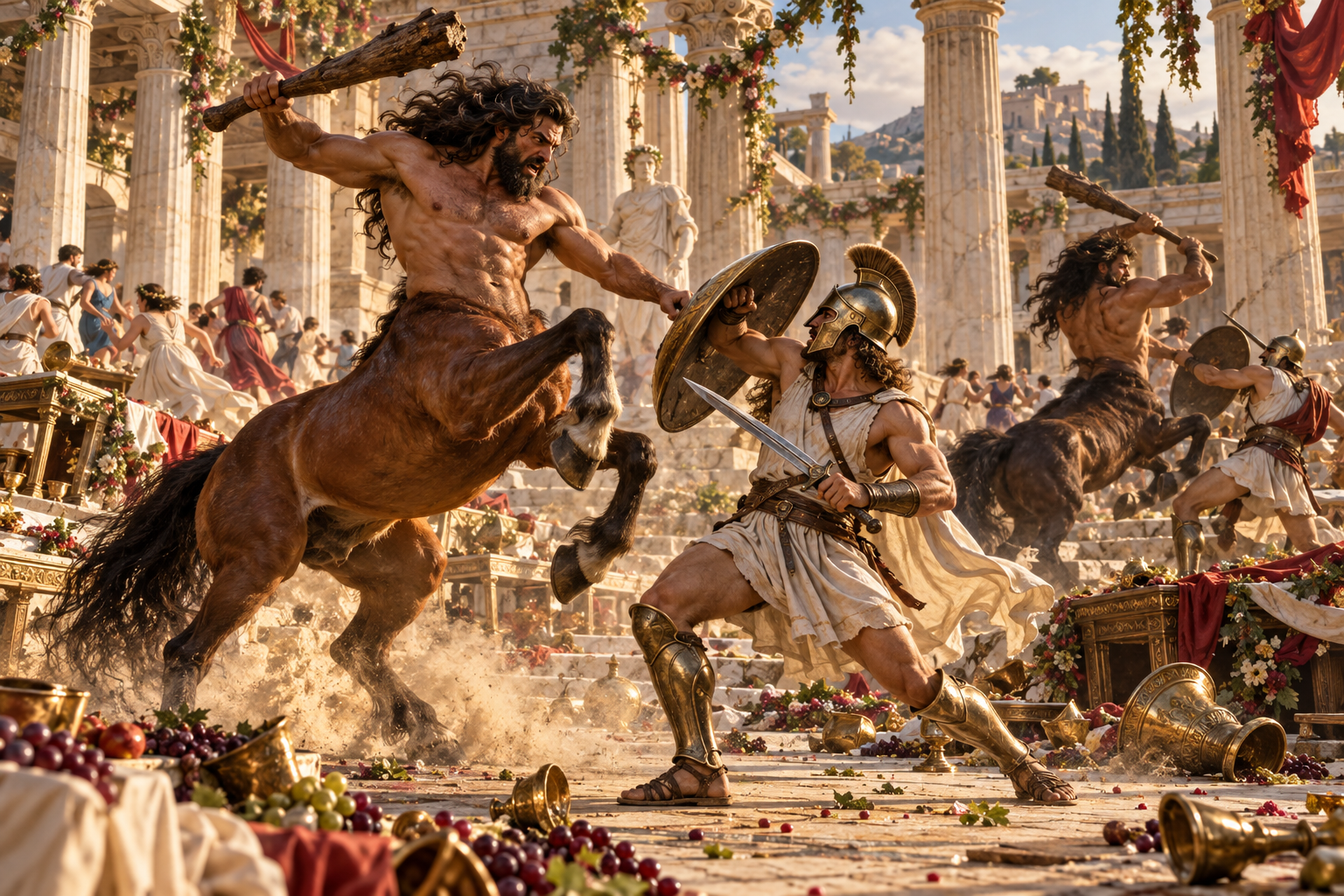 The defining centaur myth was the Centauromachy, the battle between the centaurs and the Lapiths. The defining centaur myth was the Centauromachy, the battle between the centaurs and the Lapiths.
The conflict began during the wedding celebration of the Lapith king Pirithous and his bride Hippodamia. Centaurs were invited to the wedding feast, but the wine overwhelmed them. One centaur, often named Eurytion or Eurytus depending upon the source, attempted to seize the bride. Other centaurs followed his example and attacked women attending the celebration.
The wedding erupted into violence.
The Lapiths fought back, aided by the Athenian hero Theseus. Furniture, weapons, stones, branches, and trees became weapons. The civilized wedding feast turned into chaos, and eventually the centaurs were defeated and driven away. Ovid's *Metamorphoses* later produced one of the most elaborate surviving literary versions, describing the centaurs as overwhelmed by drunkenness, lust, and aggression.
The story became extraordinarily important in Greek art. The Centauromachy appeared on painted pottery and on monumental sculpture, including the Parthenon in Athens. The Metropolitan Museum notes that centaurs appeared frequently in major fifth-century BCE artistic programs, while the Parthenon's southern metopes prominently represented their battle with the Lapiths.
To Greek audiences, the story could symbolize the struggle between civilization and barbarism. The wedding represented order: marriage, kinship, hospitality, ritual, and community. The centaurs were invited guests and therefore bound by the sacred expectations of hospitality, or xenia. By becoming drunk and attacking their hosts, they violated multiple foundations of civilized behavior simultaneously.
Yet the symbolism is more complicated than “humans good, centaurs bad.” Centaurs are partly human. The violence represented in their bodies is therefore also human violence. They externalize impulses that civilization attempts to discipline but can never entirely eliminate.
The beast is not completely outside humanity.
It is attached to it.
Caeneus: Gender, Transformation, and the Centaurs
One of the most fascinating figures in the Centauromachy is Caeneus. In Ovid's version, Caeneus had been born Caenis, a woman. After an encounter with the god Neptune, the Roman Poseidon, Caenis asked to be transformed into a man and made invulnerable so that such vulnerability could never be experienced again. The request was granted, and Caeneus became a powerful male warrior. During the Centauromachy, Caeneus killed several centaurs. Because weapons could not penetrate his body, the centaurs finally defeated him by piling trees and enormous objects upon him and forcing him into the earth.
Ovid includes an especially striking confrontation in which the centaur Latreus taunts Caeneus about his former female identity, telling him that he should abandon warfare and return to traditionally feminine work. Caeneus responds not with an argument about gender but by defeating him. Modern scholars have understandably become interested in Caeneus as a figure for thinking about gender variance in antiquity. One recent study specifically examines Ovid's treatment of Caeneus through queer and transgender interpretive frameworks. Applying modern categories directly to ancient people always requires caution, but Caeneus unquestionably makes gender transformation part of one of the central centaur myths.
The episode adds another boundary to a story already obsessed with boundaries. The centaur combines human and animal. Caeneus crosses from female to male. The wedding separates unmarried from married life. Wine separates self-control from intoxication. The entire myth takes place at points where one state threatens to become another.
Chiron: The Centaur Who Defied the Stereotype
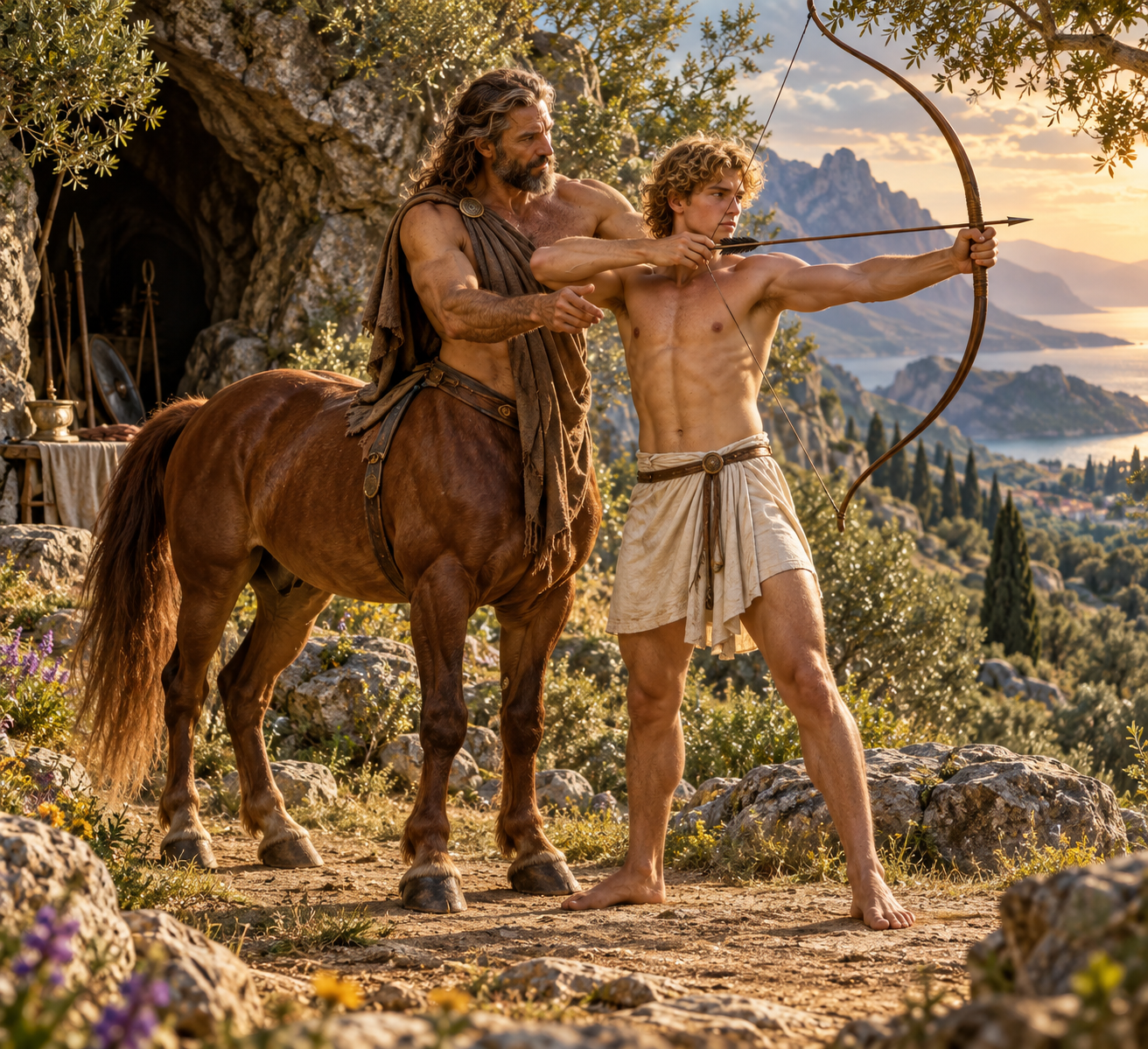 If the ordinary centaur represented uncontrolled appetite, Chiron represented what might happen when human intelligence successfully governed animal power. Chiron was wise, gentle, disciplined, and extraordinarily learned. He lived on Mount Pelion and became one of mythology's greatest teachers. Ancient traditions connected him with medicine, hunting, music, ethics, and practical knowledge. His pupils formed an extraordinary collection of Greek heroes. Achilles was entrusted to him as a boy, and Chiron instructed him in skills associated with heroic life. Traditions also connected Chiron with Jason, Peleus, Asclepius, Actaeon, and other legendary figures. Ancient literature explicitly calls him the most righteous of the centaurs, while artistic representations repeatedly show the young Achilles in Chiron's care. If the ordinary centaur represented uncontrolled appetite, Chiron represented what might happen when human intelligence successfully governed animal power. Chiron was wise, gentle, disciplined, and extraordinarily learned. He lived on Mount Pelion and became one of mythology's greatest teachers. Ancient traditions connected him with medicine, hunting, music, ethics, and practical knowledge. His pupils formed an extraordinary collection of Greek heroes. Achilles was entrusted to him as a boy, and Chiron instructed him in skills associated with heroic life. Traditions also connected Chiron with Jason, Peleus, Asclepius, Actaeon, and other legendary figures. Ancient literature explicitly calls him the most righteous of the centaurs, while artistic representations repeatedly show the young Achilles in Chiron's care.
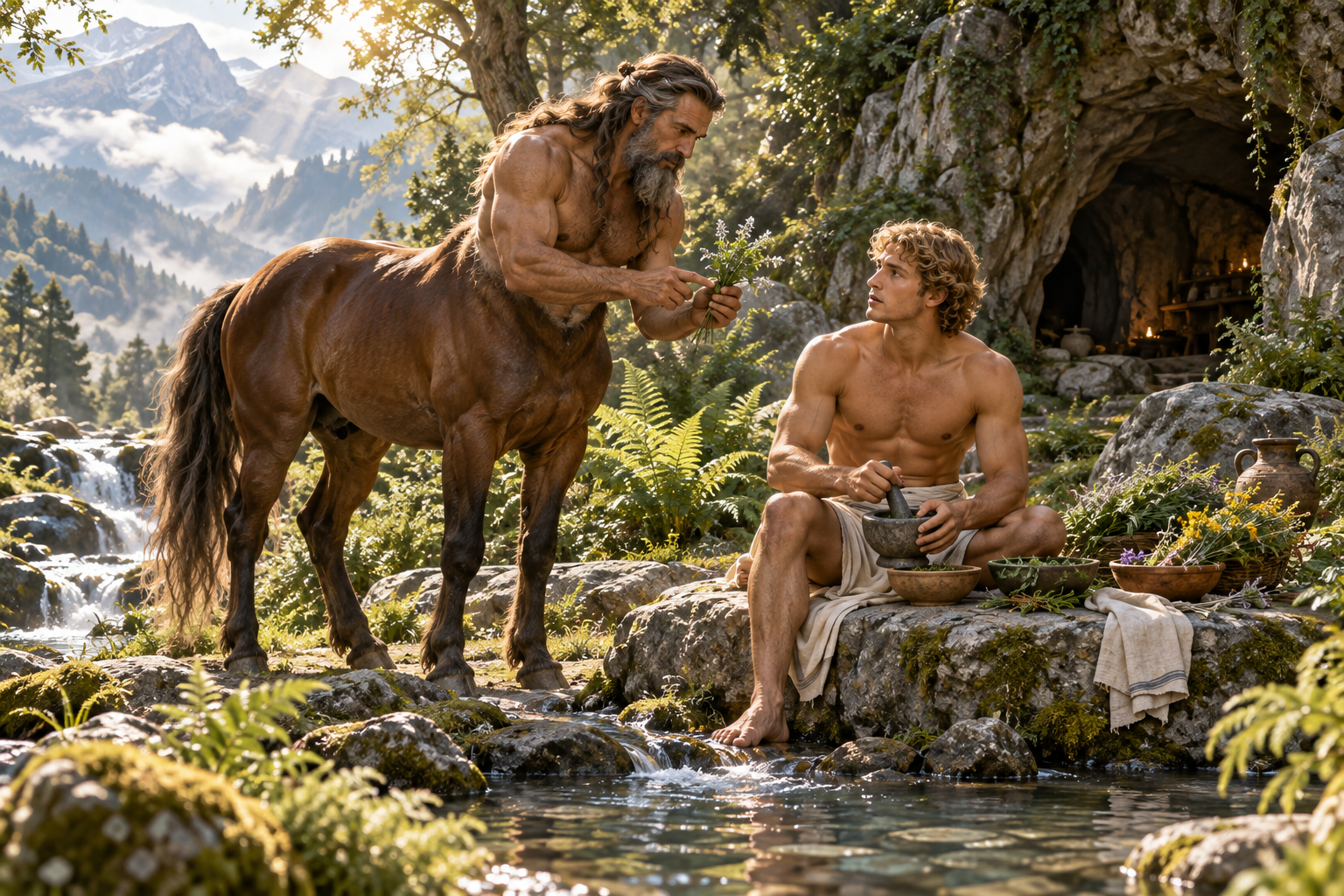 The relationship between Chiron and Achilles became one of the most enduring images associated with the centaur. Here the horse body no longer symbolizes uncontrolled lust. It symbolizes strength guided by intelligence. Chiron can teach a human prince because he has achieved something many human beings have not: harmony between instinct and reason. His death was tragic. Chiron was immortal, but he was accidentally wounded by an arrow poisoned with the Hydra's venom, associated with Heracles. Because he could not die naturally yet could not be healed, his immortality became unbearable. Traditions ultimately allowed him to surrender immortality and escape his suffering. Chiron therefore complicates every simple interpretation of centaurs. The same hybrid body capable of representing barbarism can represent wisdom. The creature itself is morally neutral; what matters is which half governs the other. The relationship between Chiron and Achilles became one of the most enduring images associated with the centaur. Here the horse body no longer symbolizes uncontrolled lust. It symbolizes strength guided by intelligence. Chiron can teach a human prince because he has achieved something many human beings have not: harmony between instinct and reason. His death was tragic. Chiron was immortal, but he was accidentally wounded by an arrow poisoned with the Hydra's venom, associated with Heracles. Because he could not die naturally yet could not be healed, his immortality became unbearable. Traditions ultimately allowed him to surrender immortality and escape his suffering. Chiron therefore complicates every simple interpretation of centaurs. The same hybrid body capable of representing barbarism can represent wisdom. The creature itself is morally neutral; what matters is which half governs the other.
Pholus, Heracles, and the Fatal Wine
Another relatively civilized centaur was Pholus, or Pholos. When Heracles visited him, Pholus welcomed the hero and offered food. Trouble began when Heracles wanted wine. Pholus possessed a jar belonging collectively to the centaurs and hesitated to open it, but eventually did so. The smell attracted the surrounding centaurs, who became enraged.
A battle followed.
Heracles fought them with his famous poisoned arrows, and many centaurs were killed. Pholus himself later handled one of the arrows and accidentally wounded himself, dying from its poison. The story repeats several major centaur themes: hospitality, wine, restraint, violence, and the catastrophic consequences of appetite. Pholus attempts to behave properly, but the presence of wine awakens the familiar disorder associated with his species.
Nessus and the Death of Heracles
Perhaps the most infamous individual centaur after Chiron is Nessus. Nessus encountered Heracles and his wife Deianira at a flooded river and offered to carry Deianira safely across. Once entrusted with her, however, he attempted to violate or abduct her. Heracles shot him with an arrow poisoned by the Hydra's blood. As he lay dying, Nessus devised revenge. He convinced Deianira that his poisoned blood could function as a love charm capable of preserving Heracles' affection. Years later, fearing that Heracles loved another woman, Deianira applied the supposed charm to a garment and sent it to him. The poison burned into Heracles' body and ultimately brought about his mortal death.
Nessus therefore embodies the centaur stereotype at its darkest: sexual aggression, betrayal of trust, animal appetite, and revenge. Yet he also becomes an essential part of the story of one of Greece's greatest heroes.
Centaurs in Greek and Roman Art
Centaurs became extraordinarily popular in ancient art because their bodies offered artists dramatic possibilities. Human muscles could twist above galloping equine bodies. Centaurs could rear, throw stones, uproot trees, fight warriors, carry youths, accompany gods, or appear in peaceful landscapes. Their visual appearance changed over time. Early examples could look awkwardly assembled, with a complete human figure apparently attached to an additional horse body. By the Archaic and Classical periods, the human torso joined more naturally to the horse at the waist, producing the anatomical model familiar today.
Their personalities changed as well. During the Classical period, violent Centauromachies emphasized wildness and the conflict between civilization and barbarism. In later Hellenistic and Roman art, centaurs could appear in the company of Dionysus and Eros in more playful, pastoral, or erotic settings. A famous artistic tradition showed young and old male centaurs controlled by Eros, turning the centaur into an image of sexual passion and the changing power of desire over the course of life.
Female centaurs, or centauresses, also appeared increasingly in later art and literature. Their existence reminds us that the overwhelmingly masculine centaur tradition was capable of expansion and reinvention.
From Antiquity to the Middle Ages
The centaur did not disappear when classical paganism declined. Medieval Europeans inherited Greek and Roman descriptions of fabulous animals through encyclopedias, bestiaries, manuscripts, and surviving works of art. Centaurs consequently entered the medieval Christian imagination, where their mixed nature could acquire moral meanings very different from those of ancient Greece. Medieval bestiaries frequently interpreted animals symbolically rather than scientifically. The centaur could represent uncontrolled lust, divided nature, or the struggle between rational and animal impulses. Medieval art sometimes connected the centaur's dual nature with evil or demonic qualities, although Chiron's reputation as a wise centaur survived as well.
During the Renaissance, renewed enthusiasm for classical mythology restored centaurs to painting, sculpture, literature, and political philosophy. They have never really left Western imagination since.
Modern fantasy has transformed them again. Centaurs appear in novels, films, role-playing games, video games, comics, and fantasy art. Sometimes they preserve the ancient image of woodland warriors. Sometimes they resemble Chiron and function as teachers or sages. In other works they have become entire fantasy civilizations with their own cultures, families, languages, and social structures.
The centaur survives precisely because the idea remains flexible.
Centaurs, Masculinity, and Sexuality
Sexuality has always been unusually important to centaur symbolism. Ancient centaurs were regularly portrayed as intensely masculine creatures governed by physical appetite. Their horse bodies amplified conventional associations with strength, stamina, fertility, aggression, and virility. Modern scholarship has accordingly described the centaur as a figure strongly associated with masculinity and male sexual drive. The Centauromachy itself begins with sexual aggression. Nessus's story revolves around uncontrolled desire. Later art connects centaurs with Dionysus and Eros. The centaur was therefore never a sexually neutral monster. Its body is part of its meaning. This is important when considering the centaur's later appeal within gay and queer culture.
Gay and Queer Associations with Centaurs
There is no basis for claiming that centaurs were fundamentally “gay creatures” in ancient Greek religion or mythology. Their best-known myths concern desire for women, and the Centauromachy explicitly portrays centaurs attacking female wedding guests. Chiron is married in some traditions and has children. Nessus desires Deianira. Any attempt to declare the entire centaur tradition secretly homosexual would distort the surviving evidence. The situation, however, is more interesting than simply saying that centaurs were heterosexual.
Ancient Greek concepts of sexuality did not map neatly onto modern categories such as gay, straight, and bisexual. Male-male erotic relationships were familiar within Greek society, though governed by conventions very different from modern relationships. Some scholarship has noted that mythological centaurs could be imagined as so sexually uncontrolled that the objects of their desire were not necessarily limited to women. K. J. Dover, in his influential study of Greek homosexuality, observed that centaurs were sometimes treated as creatures capable of pursuing attractive people of either sex. Later scholarship discussing centaur imagery has repeated this point.
There are intriguing artistic details as well. An Athenian cup dating to around 520 BCE depicts a centaur inside the vessel beside the inscription **ho pais kalos**, meaning “the boy is beautiful.” Such *kalos* inscriptions occur frequently within the social and erotic culture surrounding admired male youths. The presence of the phrase beside a centaur does not prove that the particular centaur is being depicted as homosexual, but it does place centaur imagery inside a visual and social world in which male beauty and male-male desire were openly acknowledged. There are also ancient images involving centaurs and young men. A Hellenistic terracotta from Tarentum, for example, depicts a youth riding on the back of a centaur, although the museum appropriately notes that the exact meaning of the image remains uncertain. Such objects remind us that centaur imagery was not confined entirely to scenes of men seizing women.
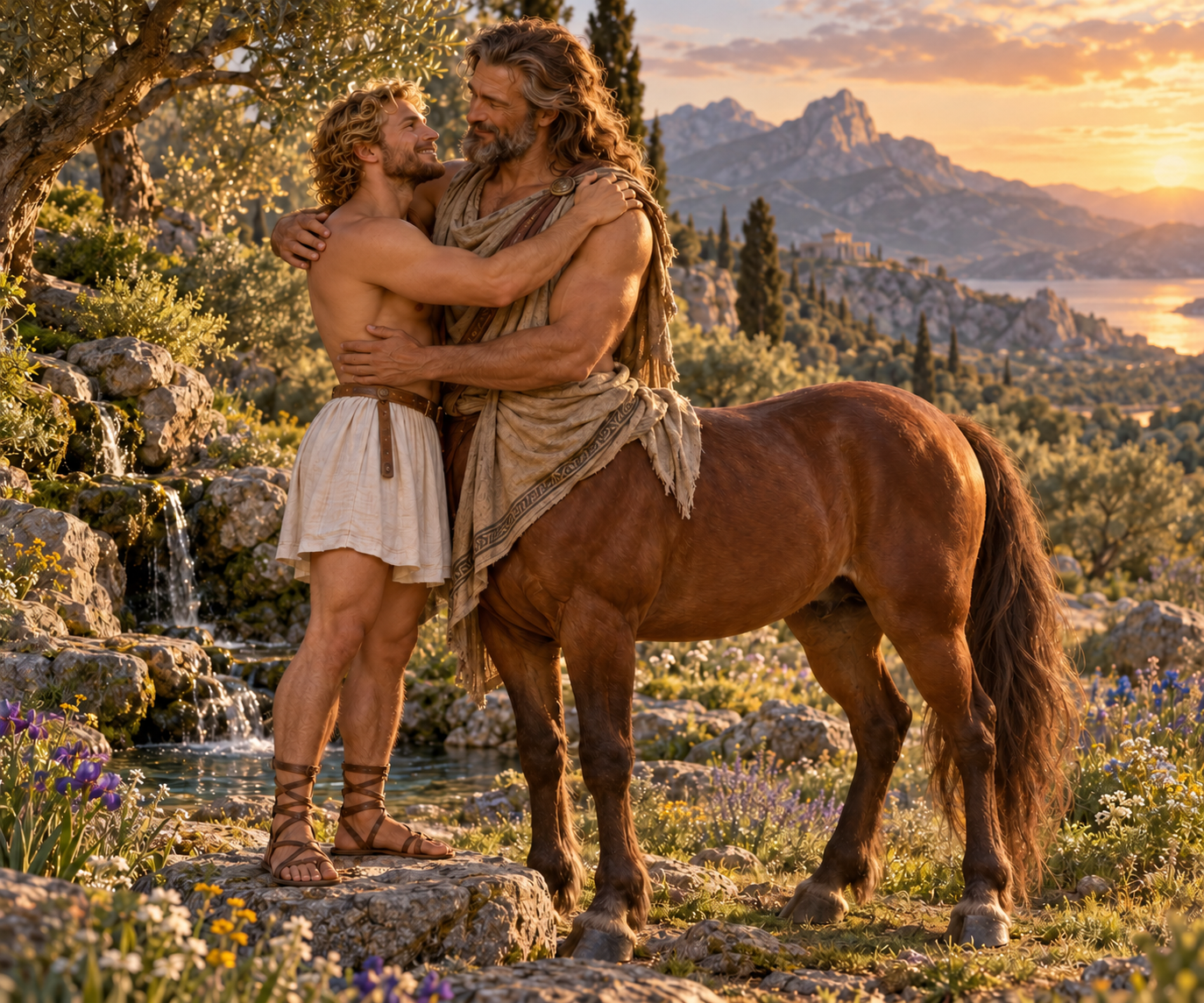 Chiron's relationship with Achilles has sometimes attracted modern homoerotic interpretation because it places a powerful adult male-bodied figure in an intimate educational relationship with an exceptionally beautiful young hero. Ancient sources, however, primarily describe the relationship as one of guardian, teacher, and pupil. It would therefore be misleading to state that Chiron and Achilles were lovers. Their relationship belongs primarily to the mythology of heroic education. Chiron's relationship with Achilles has sometimes attracted modern homoerotic interpretation because it places a powerful adult male-bodied figure in an intimate educational relationship with an exceptionally beautiful young hero. Ancient sources, however, primarily describe the relationship as one of guardian, teacher, and pupil. It would therefore be misleading to state that Chiron and Achilles were lovers. Their relationship belongs primarily to the mythology of heroic education.
The stronger queer connection emerges through symbolism rather than through a specific ancient romance.
A centaur is a body that refuses a simple category. He is human and animal simultaneously. He occupies civilization and wilderness. He represents intellect joined permanently to instinct. His very existence challenges the idea that a being must belong entirely to one side of a binary.
That quality naturally lends itself to modern queer interpretation.
Queer art and literature have frequently been interested in transformation, hybrid identity, bodies that resist conventional categories, and creatures historically treated as outsiders. The centaur offers all of these possibilities while simultaneously presenting an exaggerated image of masculine physicality. A typical modern male centaur combines a muscular male torso with the enormous power of a stallion. It is therefore unsurprising that centaurs can acquire homoerotic appeal in modern fantasy and gay art.
The imagery can operate in several directions simultaneously. A centaur can represent idealized masculinity without conventional human limitations. He can symbolize freedom from social restraint. He can represent the integration of sexuality and intellect rather than the repression of sexuality. He can also embody the experience of possessing an identity that does not fit comfortably into ordinary categories.
Modern queer interpretation becomes even richer when Caeneus is remembered. One of the central myths involving centaurs also includes a warrior who undergoes a complete change of sex and whose masculinity is directly challenged by a centaur during battle. Modern scholarship has consequently explored Caeneus as a significant figure for understanding ancient gender variance. The centaur tradition therefore contains not only homoerotic possibilities but an ancient narrative in which the stability of gender itself becomes part of the conflict.
None of this means that ancient Greeks would have recognized the modern LGBTQ+ meanings now attached to such stories. Queer readings are interpretations, not lost historical facts. But mythology survives because successive cultures find new meanings within old symbols. The centaur has proved especially capable of carrying them.
The Creature Between Worlds
Ultimately, the centaur's greatest power lies in contradiction. The ordinary centaurs are creatures of appetite, but Chiron is a master of discipline. They disrupt civilization, yet one of them educates civilization's greatest heroes. They can represent sexual violence, yet later art places them under the authority of Eros and transforms them into creatures of beauty and desire. Ancient sculptors used them to symbolize barbarism; medieval artists used them to symbolize divided human nature; modern fantasy has turned them into warriors, scholars, lovers, sages, and entire peoples.
Even their bodies tell two stories at once. The human half looks upward. It speaks, teaches, remembers, creates, and reasons. The horse half runs across the earth. It possesses tremendous strength, speed, appetite, and instinct. Neither half can be separated from the other without destroying the centaur. Perhaps this is why the figure has remained so compelling for almost three thousand years. The centaur turns one of humanity's oldest questions into flesh: are we rational beings burdened by animal instincts, animals blessed with reason, or something that can never truly be divided into either category?
Ancient Greek mythology never provides a single answer.
Instead, it gives us Eurytion and Nessus, overwhelmed by appetite; Pholus, trapped between hospitality and the violence of his kind; Caeneus, crossing the boundaries of sex and confronting creatures who themselves cross the boundary between human and animal; and Chiron, perhaps the greatest contradiction of all—the beast who teaches men how to become heroes.
For modern LGBTQ+ readers and artists, another meaning can be added without pretending that it was the only meaning intended by antiquity. The centaur can represent a body that exists successfully between categories. He can be masculine without being conventionally human, powerful without being socially domesticated, beautiful without being ordinary, and different without needing to become one thing or the other.
That may ultimately be the secret of the centaur's extraordinary longevity.
He does not resolve the conflict between man and beast, civilization and wilderness, restraint and desire, masculinity and vulnerability, or identity and transformation.
He carries all of them with him.
Four hooves upon the earth, a human face turned toward the heavens, the centaur remains forever between worlds — and completely himself.
The images below are all AI-generated by me with ChatGPT, Grok, and Google Gemini on my iPhone. Enjoy!

The 31 Days of Halloween! Click on the day number you want! 01 | 02 | 03 | 04 | 05 | 06 | 07 | 08 | 09 | 10 | 11 | 12 | 13 | 14 | 15 | 16 | 17 | 18 | 19 | 20 | 21 | 22 | 23 | 24 | 25 | 26 | 27 | 28 | 29 | 30 | 31
George
|