 Two Goats and a Donkey! Two Goats and a Donkey!
On The 22nd Day of Halloween
Thursday, October 22, 2026
Halloween and the Full Moon
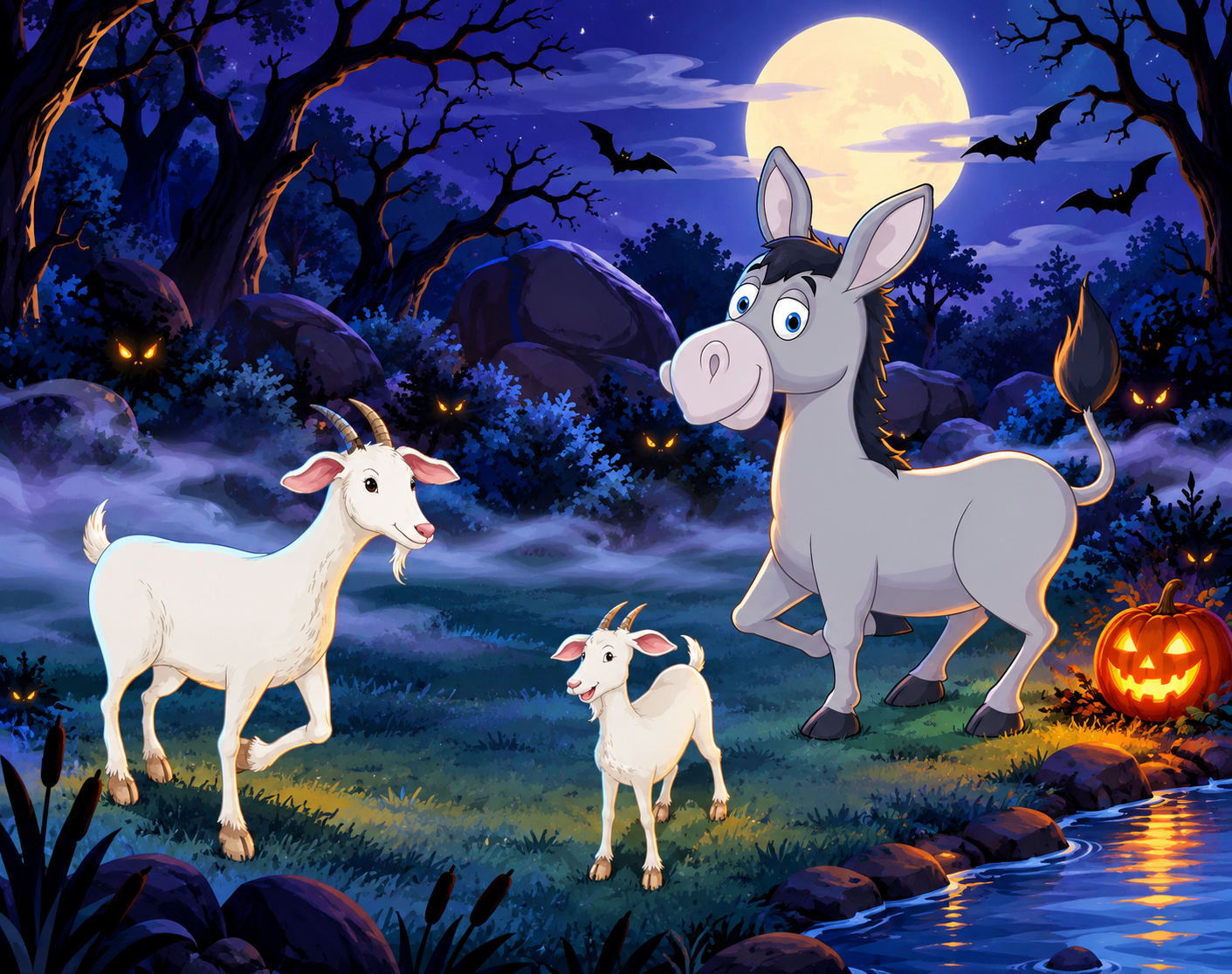
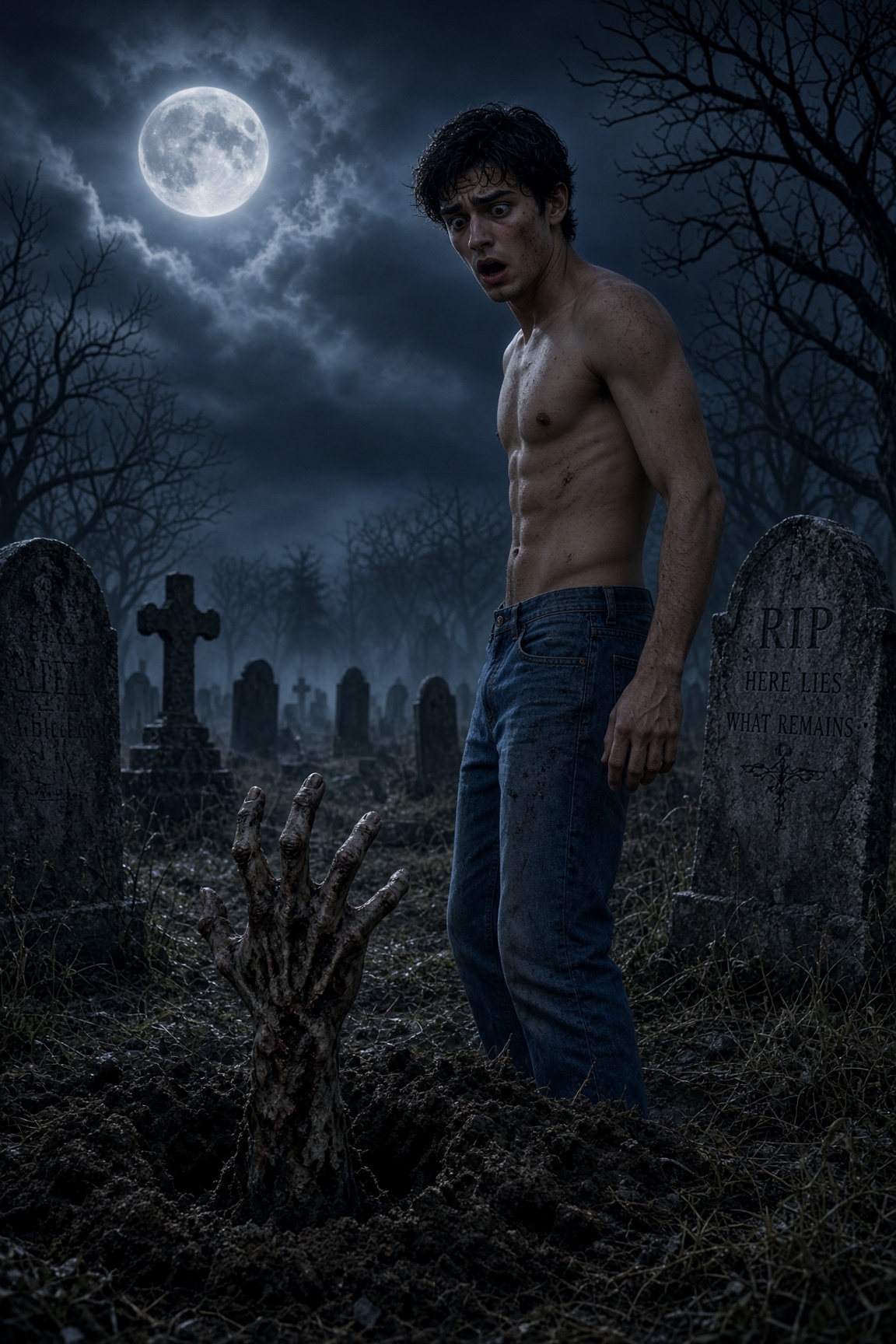
Few images seem more perfectly suited to Halloween than a brilliant full moon hanging above a dark autumn landscape. In countless Halloween illustrations, the moon rises behind a haunted house, illuminates a lonely cemetery, silhouettes a witch flying across the sky, or frames bats sweeping through the night. Werewolves howl beneath it, ghosts wander through its pale light, and bare tree branches stretch across its glowing face. The full moon has become so firmly embedded in Halloween imagery that it can seem as though October 31 and the full moon naturally belong together.
Astronomically, however, they do not. A full moon on Halloween is actually relatively uncommon. Furthermore, the moon's connection with Halloween is not simply an ancient survival from the Gaelic festival of Samhain. The familiar Halloween full moon emerged from a much broader mixture of ancient lunar awareness, autumn folklore, supernatural beliefs, Gothic literature, nineteenth-century art, and twentieth-century popular culture.
To understand why the full moon became such a powerful Halloween symbol, it is first necessary to understand what a full moon actually represents.
The moon completes its cycle of phases in approximately 29.5 days, a period known as the synodic month. During that cycle it moves from new moon through waxing crescent, first quarter, waxing gibbous, full moon, waning gibbous, last quarter, and finally back toward new moon.
Because Halloween always occurs on October 31 while the lunar cycle lasts about 29.5 days, the moon phase on Halloween changes from year to year. October 31 may therefore occur under a crescent moon, quarter moon, gibbous moon, full moon, or even near the darkness of a new moon.
Statistically, a full moon can be expected to fall on Halloween roughly once every 29 or 30 years for a particular location and time zone, although the actual intervals are irregular. Sometimes Halloween full moons occur considerably closer together; at other times decades pass between them.
The most recent widely observed Halloween full moon occurred on October 31, 2020. It was especially memorable because it was also popularly described as a “blue moon,” meaning the second full moon occurring within the same calendar month. October 2020 had already experienced a full moon on October 1, followed by another on Halloween.
Before 2020, the previous Halloween full moon visible across all United States time zones occurred in 1944. There were other cases in which the precise timing of a full moon fell on October 31 according to some time zones but October 30 or November 1 in others. This illustrates an important complication: a full moon is an astronomical instant occurring worldwide simultaneously, but the calendar date assigned to that instant depends upon where an observer lives.
Consequently, statements that a Halloween full moon occurs “once every nineteen years” or according to some other simple repeating interval are misleading. Lunar phases and calendar dates do eventually develop repeating patterns, particularly through the approximately nineteen-year Metonic cycle, but the correspondence is not exact enough to guarantee that every nineteenth Halloween will have a full moon.
The rarity of an actual Halloween full moon makes its overwhelming presence in Halloween art all the more interesting.
Its symbolic importance begins with something very simple: Halloween is fundamentally a nighttime celebration.
The older Gaelic festival of Samhain marked the transition into the darker portion of the year. By late October in Ireland and Scotland, daylight has shortened dramatically. Agricultural work is changing, vegetation is dying back, winter approaches, and darkness increasingly dominates daily experience.
Medieval Irish literature repeatedly associates Samhain with extraordinary events and encounters with the supernatural. Later Gaelic folklore continued to treat the season as a time associated with spirits, fairies, divination, and unusual dangers. This does not mean that the ancient Celts celebrated Samhain specifically beneath a full moon. There is no convincing historical evidence that Samhain required a particular lunar phase.
Nevertheless, the moon naturally belonged to the nighttime environment in which later Samhain and Halloween traditions developed.
Ancient Celtic peoples were certainly attentive to lunar cycles. The famous Coligny Calendar from Roman-era Gaul demonstrates a sophisticated calendrical system in which lunar months played an important role while adjustments helped maintain alignment with the solar year. Classical writers also commented upon Celtic methods of reckoning time.
This has sometimes led modern writers to claim that ancient Samhain was necessarily celebrated on a particular full moon. The evidence does not justify such certainty. The relationship between ancient Celtic calendars and later Gaelic festival dates is complicated, and we cannot simply project modern reconstructions backward and declare that Samhain was universally a “full moon festival.”
The broader symbolic relationship between the moon and Samhain is nevertheless compelling.
The moon is itself an image of transition.
Unlike the sun, which appears relatively constant from day to day, the moon visibly changes. It grows from darkness into a slender crescent, expands toward fullness, then diminishes again until it disappears. It therefore provides an obvious natural symbol of birth, growth, fullness, decline, death, and renewal.
Samhain possesses a similar cyclical character. It occurs when the flourishing vegetation of summer has declined, harvest has ended, and the land moves toward winter dormancy. Yet winter is not permanent. Spring remains hidden beyond it.
The moon's endless waxing and waning therefore mirrors one of the fundamental ideas underlying seasonal festivals: endings eventually become beginnings.
The full moon is particularly powerful because it represents the culmination of that cycle. At fullness, the moon appears complete. From that point onward, it begins to diminish.
Symbolically, this makes the full moon another kind of threshold.
And thresholds are central to Samhain.
Samhain stands between autumn and winter, harvest and dormancy, the lighter and darker portions of the year. Medieval stories often place supernatural encounters at Samhain precisely because it is portrayed as a time when normal divisions become uncertain.
The full moon similarly occupies a transitional point between waxing and waning.
This does not prove an ancient ritual connection between the two. It does explain why they work so powerfully together as symbols.
The moon also transforms darkness without destroying it.
Sunlight makes the world ordinary again. Moonlight does something very different. It reveals shapes while preserving shadows. A field, forest, cemetery, or ruined building visible under moonlight remains mysterious. Objects can be recognized but not completely understood.
That quality makes moonlight ideally suited to supernatural storytelling.
The human imagination fills what cannot clearly be seen.
A tree becomes a figure. A distant animal becomes something stranger. Mist glows across a field. Movement at the edge of vision seems more significant because darkness conceals its source.
For generations living without electric lighting, moonlight was also immensely practical. A bright full moon could make nighttime travel easier. Roads, fields, and pathways became more visible. Agricultural societies paid close attention to the moon partly because its light had real consequences.
Halloween inherited this nocturnal fascination.
Christianity added another layer to the season. The feasts of All Saints and All Souls placed remembrance of the dead at the beginning of November. Over centuries, these observances interacted with existing seasonal customs. The night before All Saints—All Hallows' Eve—became Halloween.
Ghosts and the dead therefore became increasingly prominent within the symbolism of the season.
Moonlight provided the perfect landscape for them.
The ghost itself resembles moonlight in an interesting way: pale, visible, yet insubstantial. Both belong to the world of night. Both reveal something that seems suspended between presence and absence.
The cemetery under a full moon eventually became one of the defining images of Gothic culture.
During the eighteenth and nineteenth centuries, Gothic literature intensified European fascination with ruins, graveyards, castles, ghosts, supernatural beings, and ominous landscapes. Artists and illustrators repeatedly employed moonlight because it instantly created an atmosphere of mystery.
Halloween imagery absorbed this visual language.
The full moon subsequently acquired companions that had little or nothing specifically to do with ancient Samhain.
One was the witch.
European ideas about witchcraft developed through complicated medieval and early modern histories. The familiar Halloween witch flying across the moon on a broomstick is largely a product of later folklore and artistic representation rather than an ancient Celtic Samhain image.
Yet the silhouette became irresistible.
A witch crossing a bright circular moon can be recognized instantly, even without detail. The moon effectively becomes a giant illuminated background against which the supernatural figure appears.
The same is true of bats.
Bats are naturally creatures of twilight and darkness. When depicted crossing a full moon, their silhouettes become immediately visible. Thus the moon became not merely another Halloween symbol but the backdrop against which other Halloween symbols could be displayed.
Then came the werewolf.
The popular belief that a person transforms into a werewolf specifically during the full moon is much more recent than many people assume. European werewolf folklore is centuries old, but the rigid rule connecting transformation with the full moon was greatly strengthened by nineteenth- and twentieth-century fiction and especially cinema.
Horror films made the full moon almost inseparable from the werewolf.
Once that happened, Halloween inherited the association as well.
By the twentieth century, popular culture had assembled nearly the complete modern Halloween moon scene: a full moon, crooked trees, flying bats, witches, graveyards, haunted houses, wolves, clouds, and glowing jack-o'-lanterns.
Astronomical accuracy hardly mattered.
The moon was there because Halloween looked right beneath it.
There is also an interesting relationship between the full moon and the jack-o'-lantern. Both provide light within darkness, but in opposite ways.
The moon is remote, cold, and unreachable.
The jack-o'-lantern is close, warm, and human-made.
One illuminates the landscape from the heavens; the other illuminates the doorstep.
Together they recreate one of Halloween's fundamental symbolic contrasts: darkness is never complete because some light always remains within it.
The full moon also complements Halloween's traditional colors. Orange represents autumn leaves, harvest, pumpkins, and fire. Black represents darkness, night, death, and the unknown. The moon introduces silver or white—the pale illumination that allows the hidden world to become partially visible.
It is therefore easy to understand why artists choose a full moon even when October 31 actually occurs beneath a crescent.
A crescent moon suggests nighttime.
A full moon transforms nighttime into a stage.
Its circular shape dominates the sky, draws the eye, and provides an enormous natural halo behind whatever frightening figure the artist wishes to display.
Yet the actual rarity of a Halloween full moon arguably makes the real event more meaningful.
Most Halloweens occur beneath some other lunar phase. The iconic full moon exists primarily in our collective imagination. When October 31 genuinely coincides with the full moon, the astronomical sky briefly resembles the fictional Halloween landscape humans have been creating for generations.
There is something wonderfully appropriate about that coincidence.
Halloween is itself a celebration in which imagination overlays reality. Ordinary houses become haunted houses. Neighbors become witches and monsters. Pumpkins acquire faces. Children become ghosts. Plastic skeletons rise from suburban lawns. Familiar streets become theatrical landscapes after sunset.
The full moon performs a similar transformation naturally.
Under its light, familiar surroundings appear changed without actually becoming different.
That is perhaps the deepest reason the full moon belongs to Halloween.
It is not because every ancient Celt stood beneath one at Samhain. They did not. It is not because October 31 naturally corresponds with the lunar cycle. It does not. And it is not because Halloween requires a full moon. Most Halloweens do not have one.
The connection survives because the full moon expresses Halloween's central symbolic language extraordinarily well.
It is light existing within darkness.
It reveals while simultaneously concealing.
It changes continually while always returning.
It marks a moment of fullness immediately before decline.
And it transforms an ordinary landscape into something strange.
In that respect, the Halloween full moon resembles Samhain itself. Both occupy the imagination at a boundary: between light and darkness, certainty and mystery, the familiar and the unknown.
Statistically, the moon may be completely full on October 31 only about once in three decades at a given location. Culturally, however, it is full every Halloween.
It rises behind every imaginary haunted house.
It shines over every imaginary graveyard.
Witches cross it, bats circle it, wolves howl beneath it, and ghosts wander through its pale illumination.
The real moon follows its own ancient astronomical rhythm, indifferent to the date printed upon the human calendar. But the Halloween moon belongs to another kind of calendar—the calendar of folklore and imagination.
And there, on the night when autumn moves closer toward winter and the world seems just a little stranger after sunset, the moon is always full.
The images below are all AI-generated by me with ChatGPT, Grok, and Google Gemini on my iPhone. Enjoy!

The 31 Days of Halloween! Click on the day number you want! 01 | 02 | 03 | 04 | 05 | 06 | 07 | 08 | 09 | 10 | 11 | 12 | 13 | 14 | 15 | 16 | 17 | 18 | 19 | 20 | 21 | 22 | 23 | 24 | 25 | 26 | 27 | 28 | 29 | 30 | 31
George
|